
Cotonou, Benin
We stopped in Benin, rhymes with "so clean," and went on a Regent excursion exploring West African voodoo and the history of the slave trade.


Cotonou, on the Gulf of Guinea, is Benin’s chief seaport and commercial center. At the beginning of the 19th century, Cotonou was a small fishing village dominated by the powerful Kingdom of Dahomey, with its elite corps of Amazon warriors. In the 19th century, it became a French trading enclave and colony. The country gained its independence from French colonial rule on August 1, 1960. — Regent
Weather in mid-May:
The coastal climate features consistent tropical warmth heavily influenced by the Gulf of Guinea:
Daytime high temperatures hover around 86°F to 88°F, while nighttime lows rarely drop below 77°F to 79°F. Because of the intense humidity, the temperature feels much hotter. (Spot on — our pre-cruise research has proven exceptionally accurate.)
Rainfall: Mid-May marks the accelerating phase of the long rainy season. There is an average of 14 to 21 rainy days across the month, delivering roughly 7-8 inches of total precipitation. Rain often arrives in heavy, short tropical downpours. (Heavy rain was forecast, and our bus was filled with a bevy of umbrellas, raincoats, and folded ponchos; that must have satisfied the weather gods, because, although there was dense cloud cover at times, we had no precipitation!)
We boarded a well-appointed tour bus for the 5.5-hour, Regent-choice excursion, Ouidah, The City of Voodoo, with a cost of $229 USD per person, discounted to $195 pp.
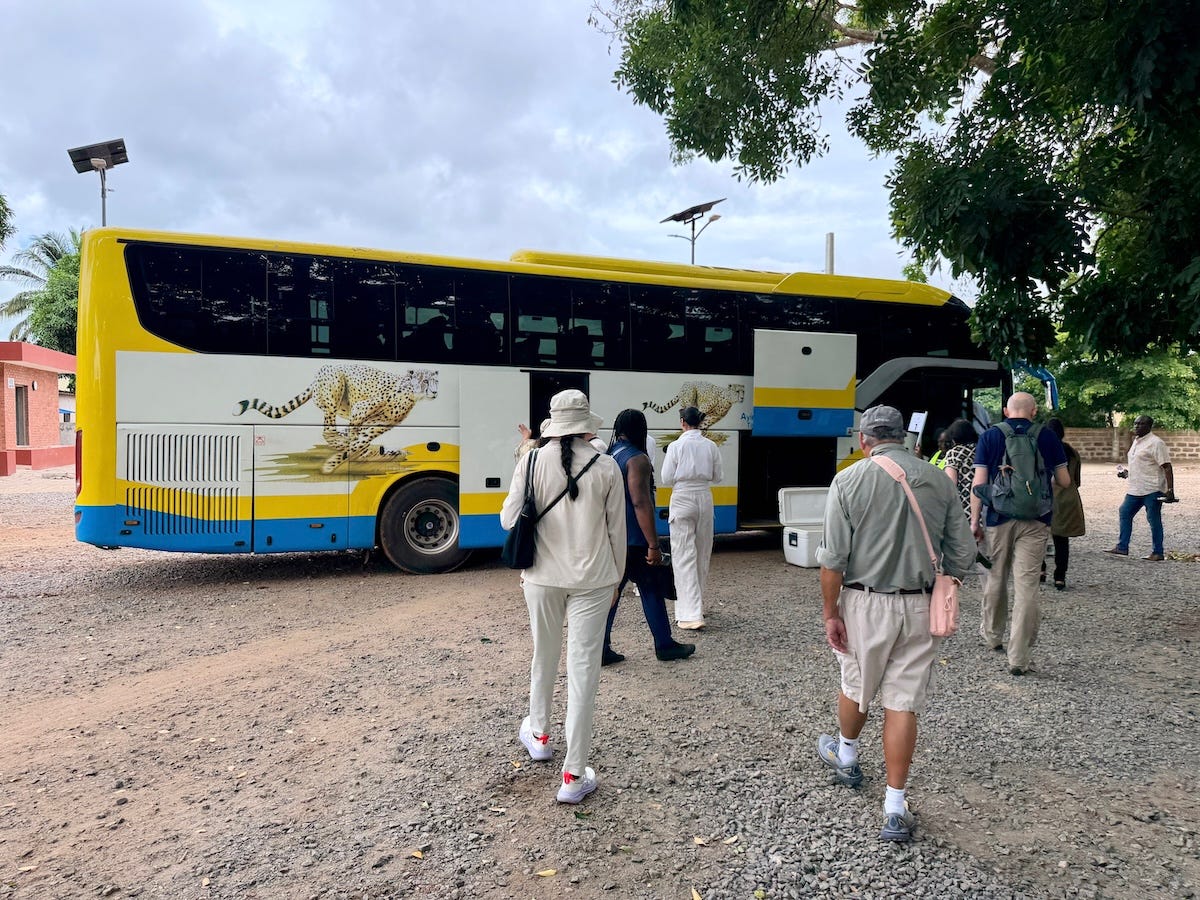
We drove from the port of Cotonou to Ouidah, a distance of only 27 miles, but it took about 1 hour and 20 minutes. We ran into somewhat chaotic traffic because we were traveling in morning rush hour traffic, even though we had a police escort to smooth the way. (We also had an armed security guard, and a medical escort, plus two tour guides were on each bus.)


The first item of interest we passed was the Wall of Heritage Murals — the longest graffiti wall in Africa and the second longest in the world. The murals stretch nearly .8 mile and document Benin's history, Dahomey warriors, and local folklore. Over 40 graffiti artists from across Benin, Africa, and international graffiti hotbeds like Brazil, have gathered over the years to paint the murals during Cotonou’s annual street art festival.
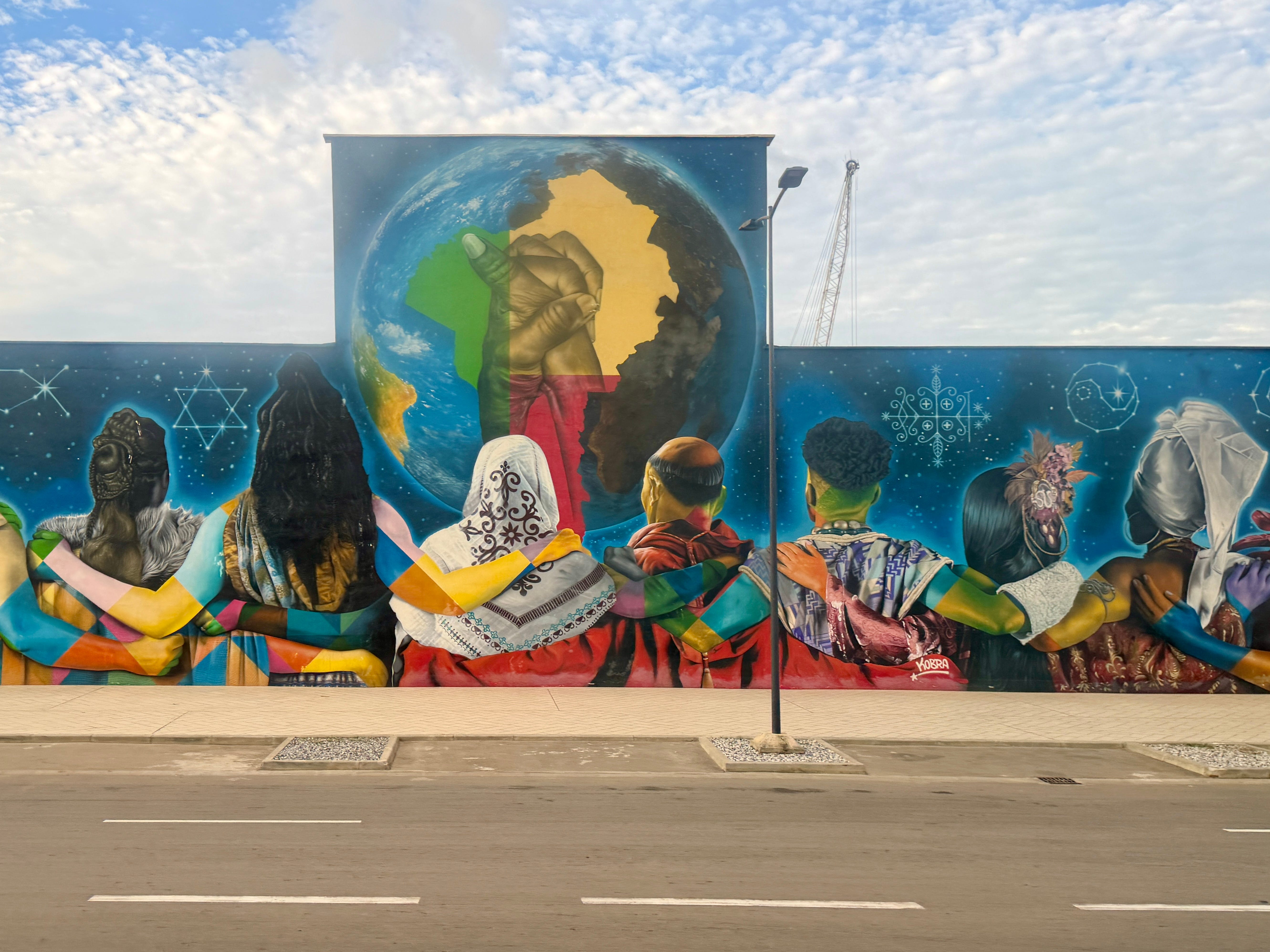
The murals also focus heavily on peaceful coexistence, featuring pieces like the famous Interfaith Dialogue work by Brazilian muralist Eduardo Kobra, which portrays people from different religions, arm in arm.
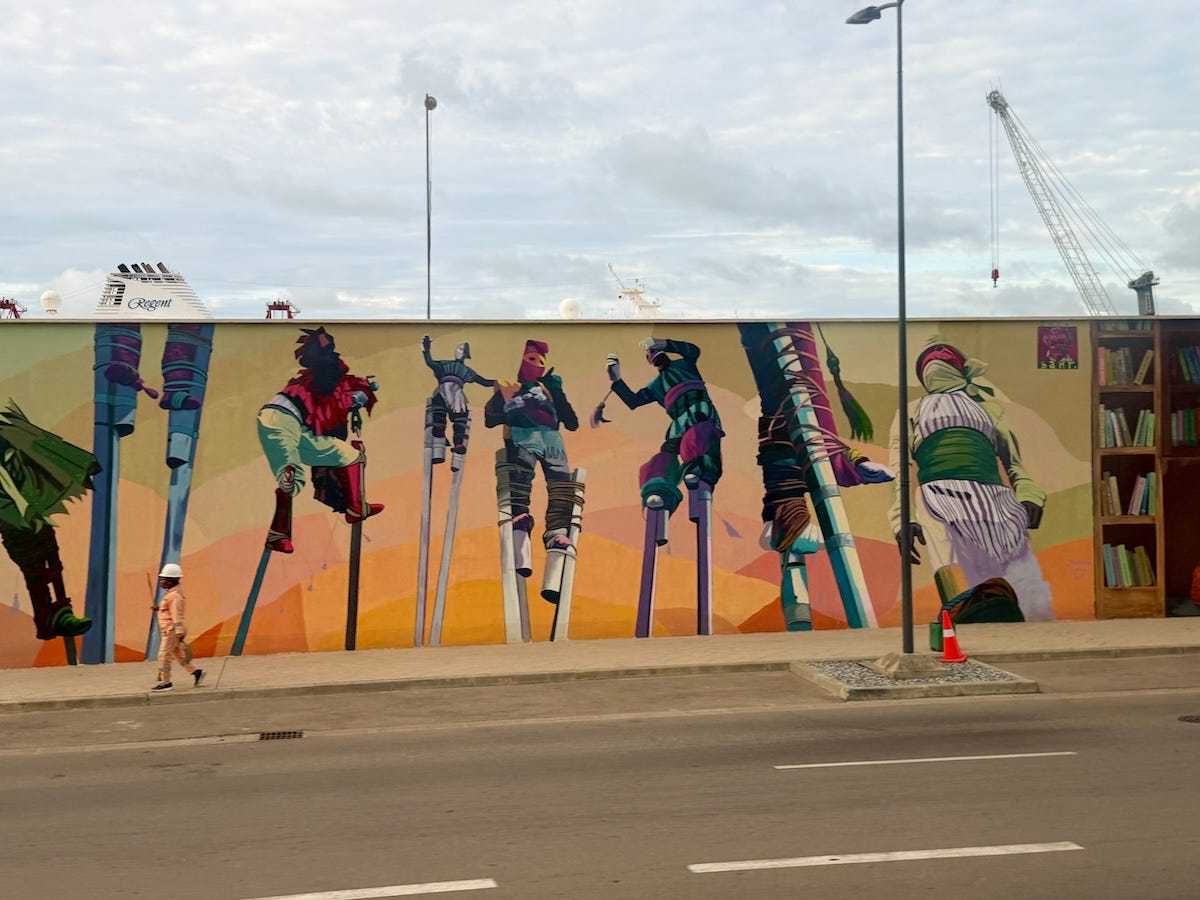
The Stilt Walkers represent the festive and spiritual traditions of Benin, such as the Chakaba spirit masquerades. In local customs, stilt-walking characters are seen as guardians who dance to rhythmic drumming to ward off evil and purify the community during major festivals. Since we’ve admired the stilt walkers at several of the folklore dance exhibitions and at port welcome ceremonies, it was fun to see the stilt-walkers featured on a mural.
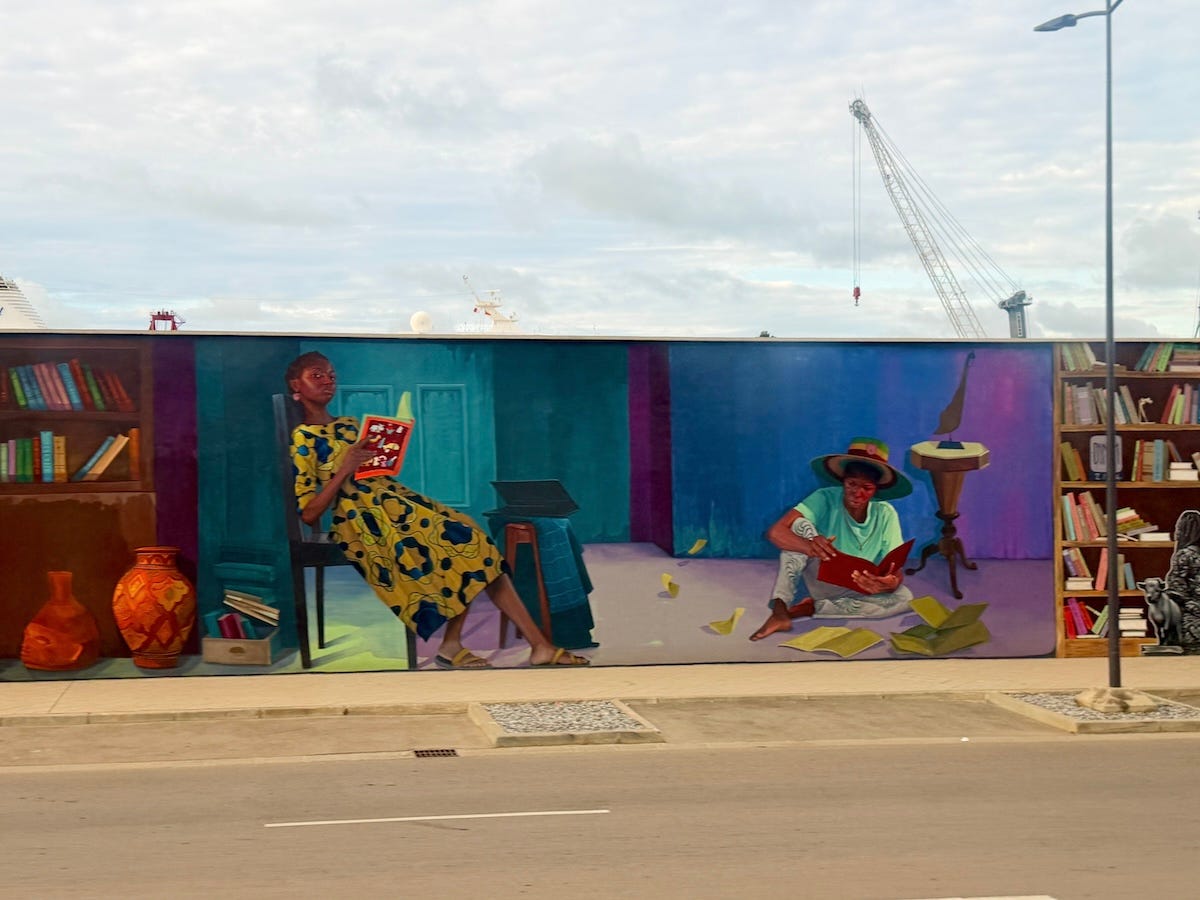
Part of the wall also uses books to represent the preservation of culture, the importance of education, and the vision of a "New Benin" in modern Africa. This section contrasts with the segments that depict ancient Dahomey kings and Voodoo customs, and emphasizes how African storytelling has evolved from an oral tradition to globally acclaimed literature.
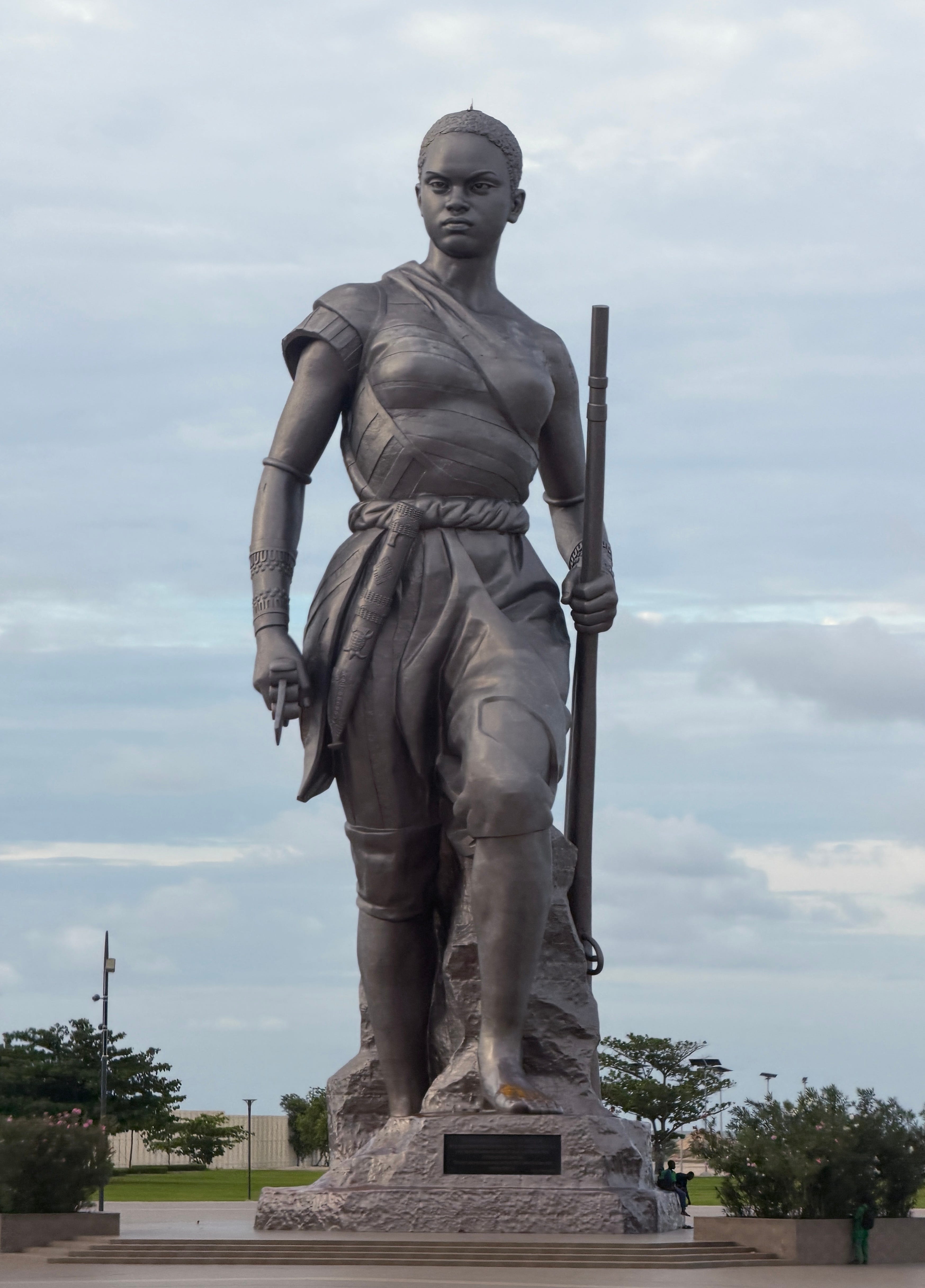
Next we passed the Amazon Monument, a towering 98-foot bronze sculpture which is the second-tallest statue in Africa and a tribute to the Agojie, the legendary, all-female military regiment of the pre-colonial Kingdom of Dahomey. Operating from the 17th century until the late 19th century, they are now celebrated as one of the only documented all-women combat units in modern military history.
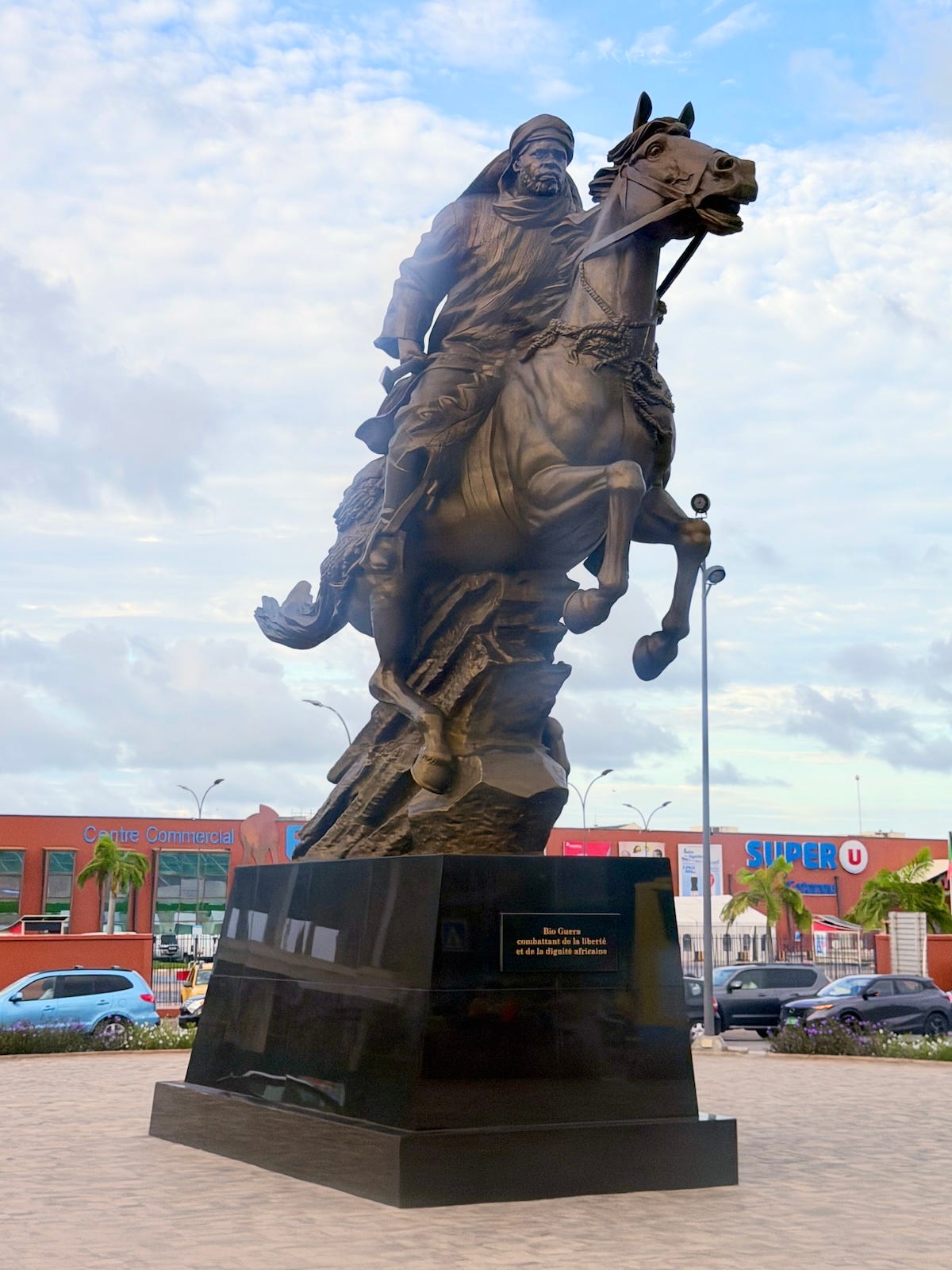
The Monument Bio Guéra, a 33-foot equestrian sculpture, was located along the highway, just minutes from the Amazon Statue. This cast iron and steel masterpiece symbolizes the anti-colonial resistance movement.
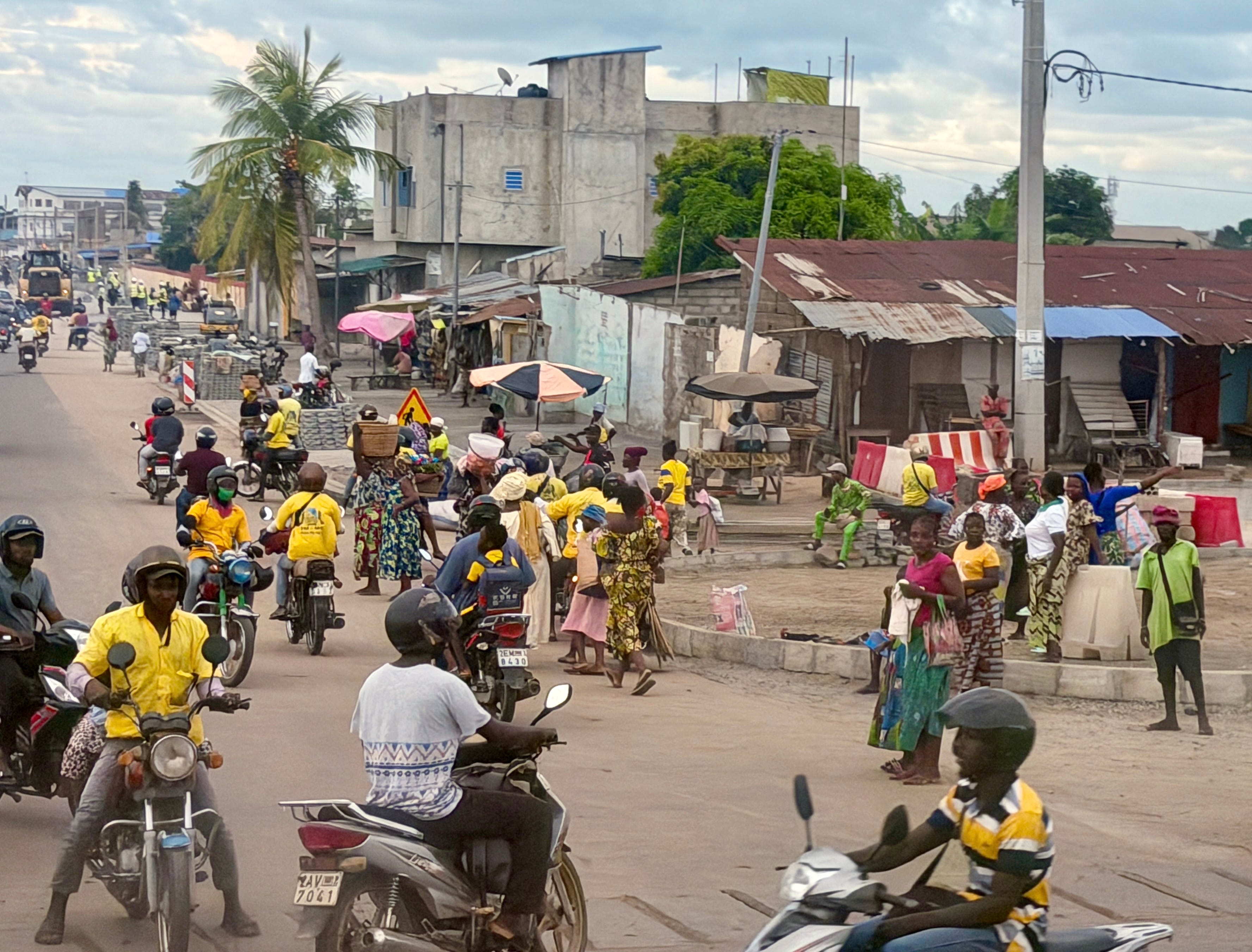
Our guide asked us if we knew why so many motorcyclists were wearing yellow shirts. No one knew. They wear bright yellow shirts to signify they are driving a motorcycle-taxi known as Zémidjans. The word comes from the local Fon language. Zé (take), mî (me), and djan (quickly), or “take me quickly.”
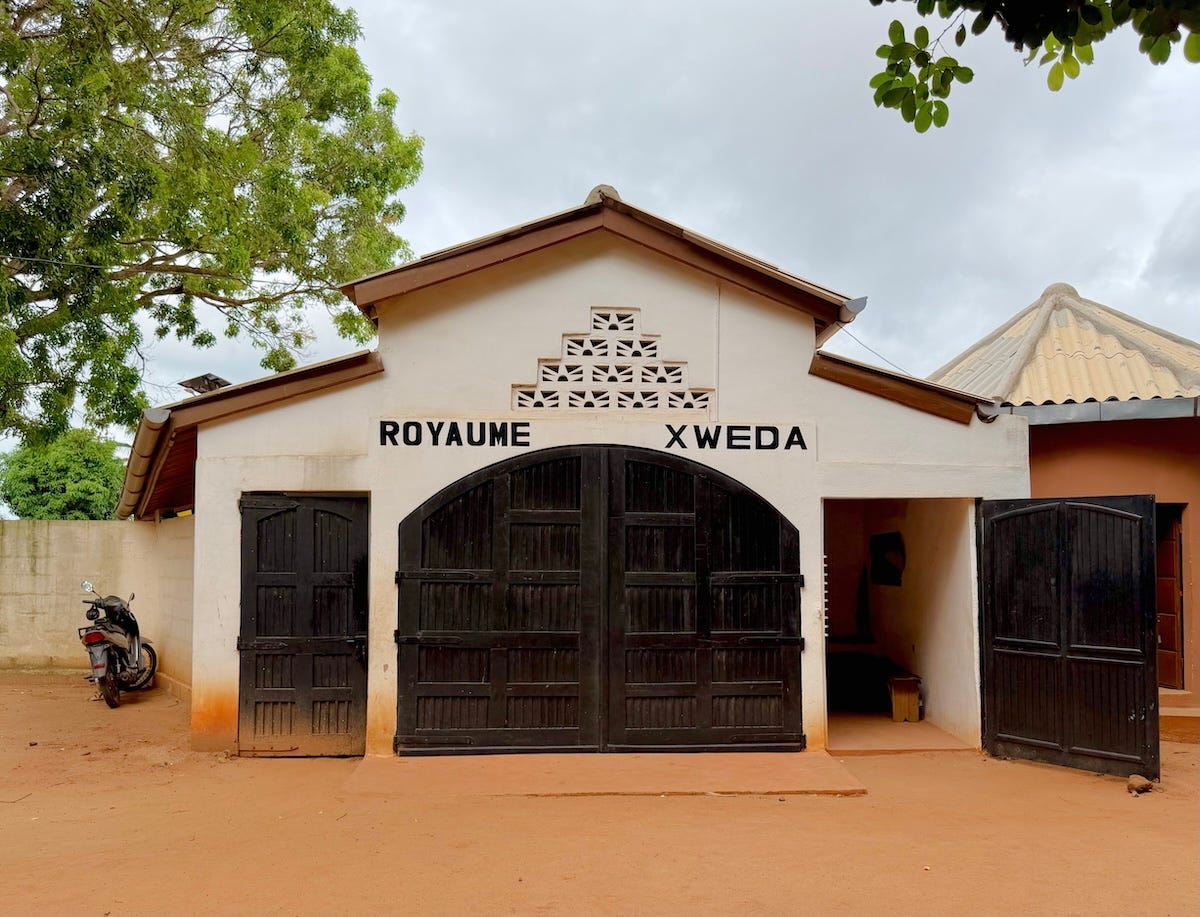
Key Highlights of the Excursion:
Depart for Ouidah to visit the Sacred Forest (once the private residence of the first King of Ouidah) an important voodoo shrine.
Temple of Pythons (Temple des Pythons): Visit this sacred Vodun shrine where there are dozens of royal pythons, symbols of protection and life.
Casa do Brasil:, a historical museum that’s a vital cultural landmark dedicated to preserving the memory of the transatlantic slave trade. (The Ouidah Museum of History is currently closed for renovations — this was a substitution.)
The Slave Auction Square and Slave Route (La Route des Esclaves): Retrace the final path taken by captives to the coast, passing the Tree of Forgetting and memorial sites.
Stop at Voodoo Sakpata Square to witness a Sakpata dance.
The Gate of No Return (Door of No Return): Stand before the UNESCO-listed memorial arch on the beach that honors the millions who were deported during the Atlantic slave trade.
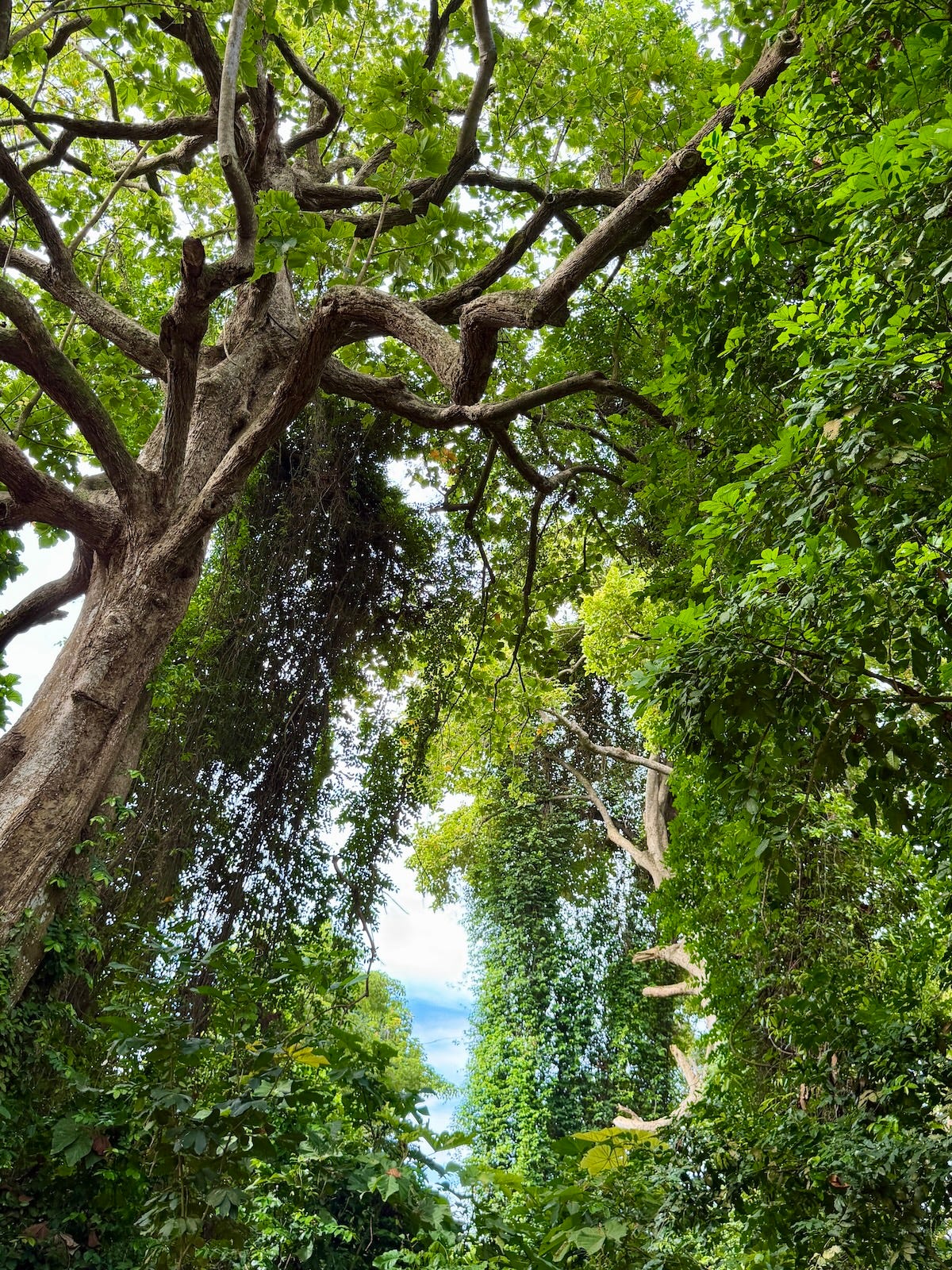
There are nearly 3,000 sacred forests in Benin. They are considered natural sanctuaries and are protected by a first-of-its-kind national law. Traditional Vodun communities revere the forests as the earthly residences of deities, ancestral spirits, and protective gods.
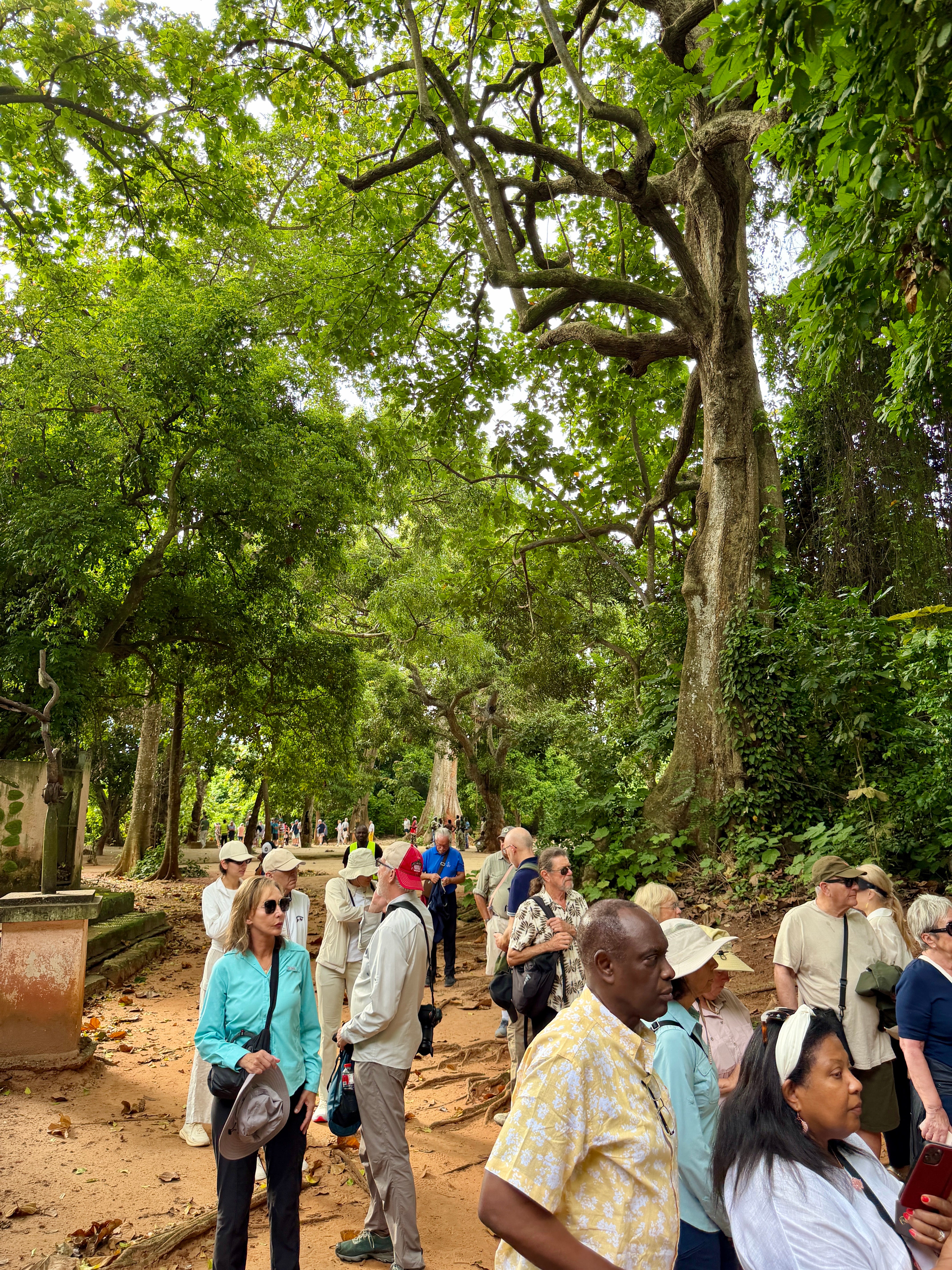
We arrived at the Sacred Forest in Ouidah, the first stop on our excursion, after our long but interesting bus ride. Half of the 10-acre forest is open to visitors. The other half of the forest was off-limits to visitors, reserved for ritual initiations and traditional ceremonies.
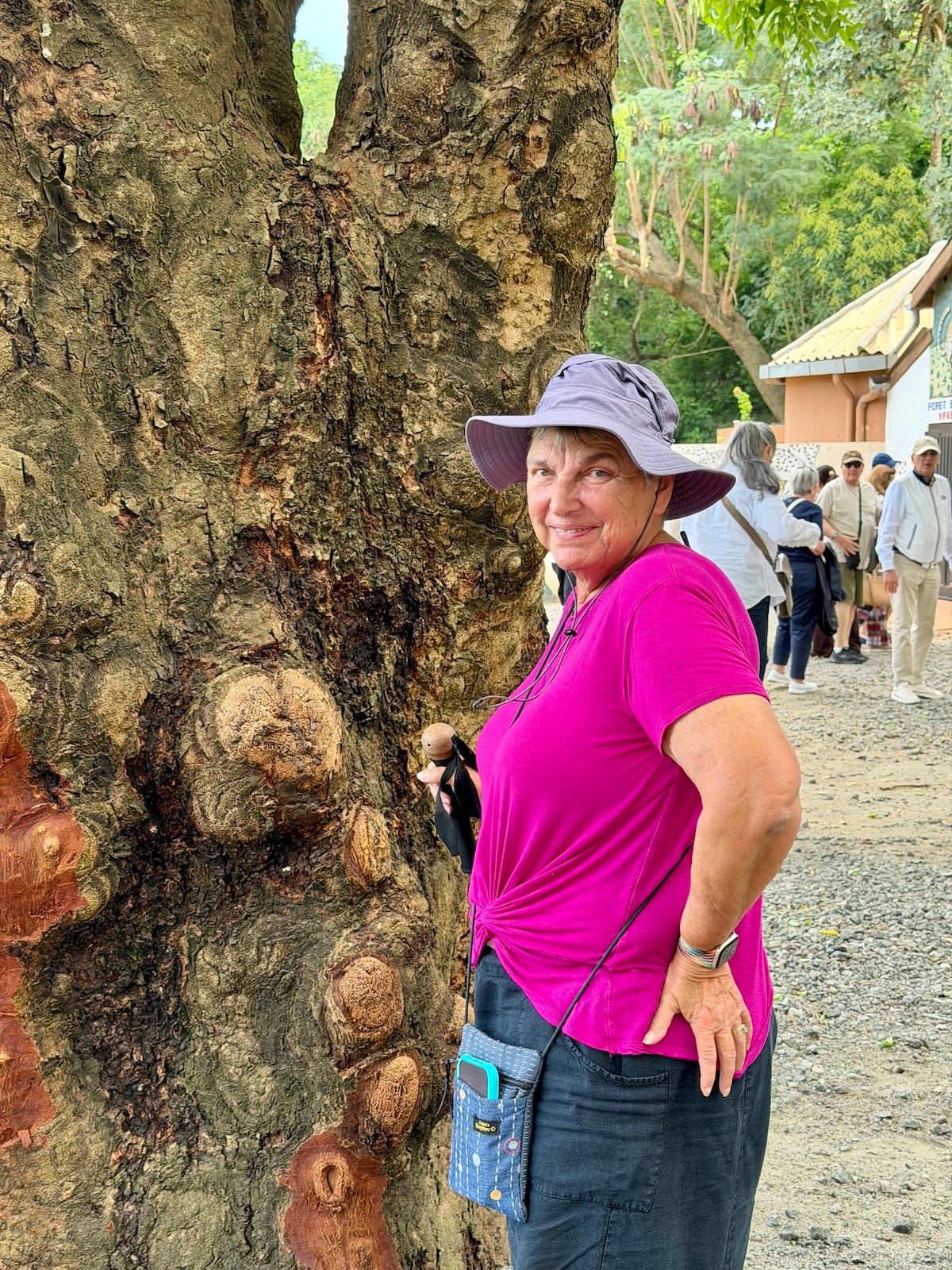
If you know me personally, you likely know that I am a tree hugger! I love trees. And I loved this ancient tree at the entrance to the Sacred Forest. The guide was unable to tell me what kind of tree it was, but it was knobby and beautiful. Research says it’s an African Teak, known locally and across West Africa as the Iroko tree.
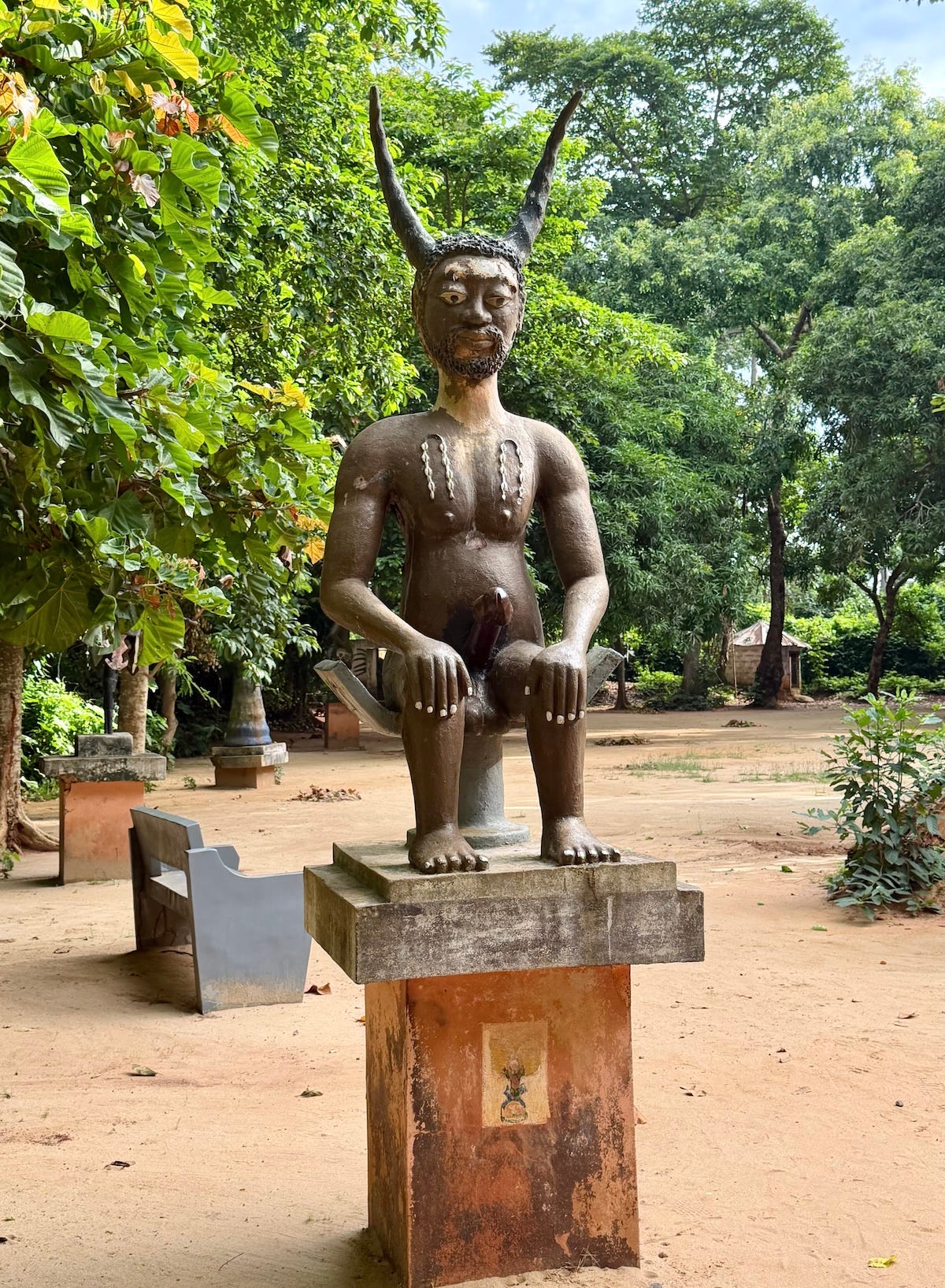
One of the first statues we saw was hard to ignore! Legba, whose sacred statue was immediately prominent with its distinct horns and a large erect phallus, is considered a protector divinity. Legba serves as the “ultimate guardian of the crossroads, gates, and human communication” for the Beninese Vodun.
(Vodun — also spelled Voodoo, Voudon, or Vodou — is the highly organized and ancestral indigenous religion native to the West African coast.)


We walked along a circular path lined with wooden, bronze, and iron statues representing major Vodun deities who manage different aspects of the earthly realm — there are deities who strike down thieves and liars, protect against smallpox and other diseases, exact revenge, cut through obstacles, manifest wealth, offer protection from the enemy, plus a plethora of other powers.
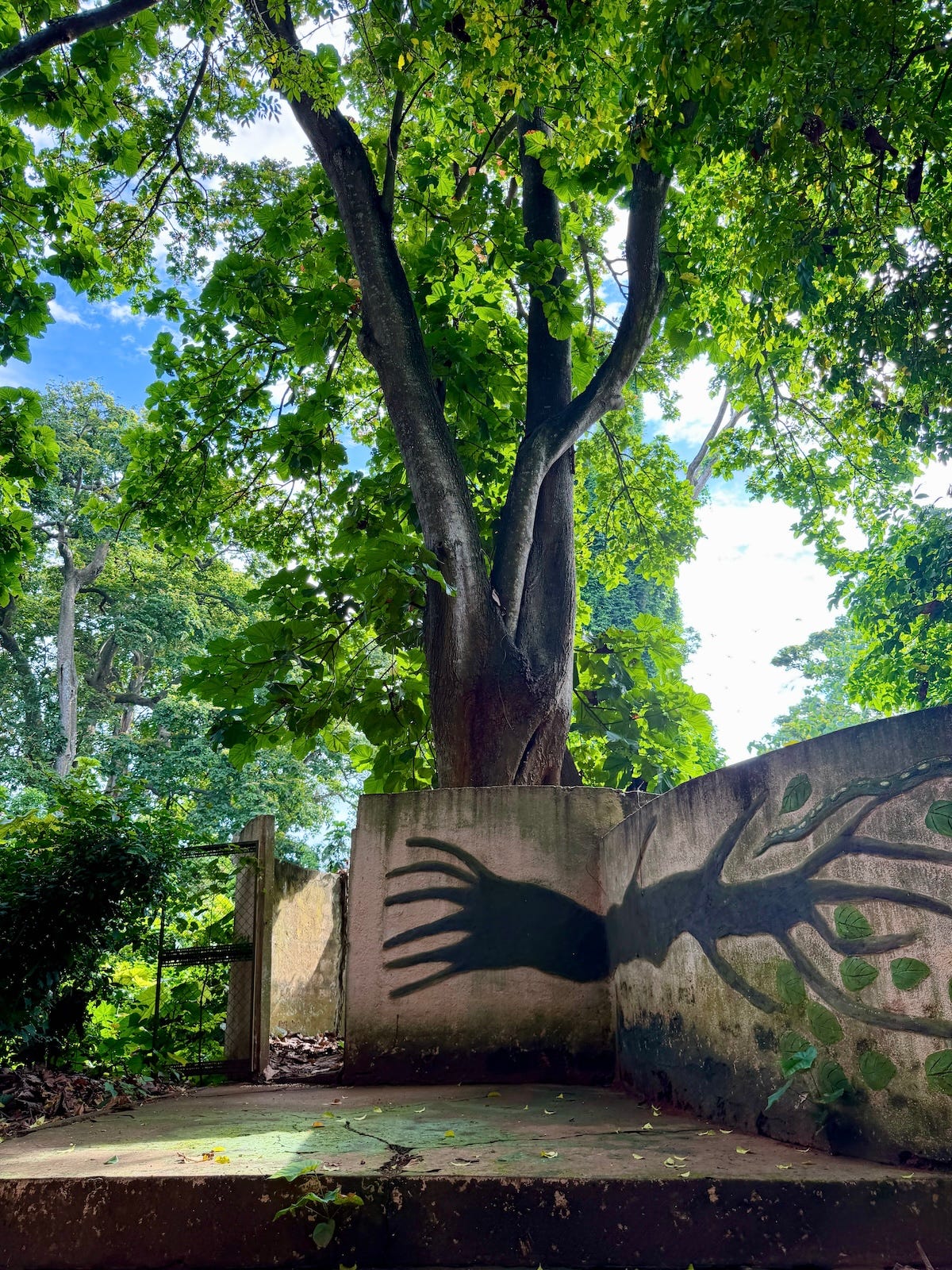
According to our guide, tradition says that this sacred tree fell during a storm. It was on the ground for 41 days, but on the 41st day, the tree stood itself upright again and re-rooted itself into the earth. The mural on the wall preserves the memory of this event.
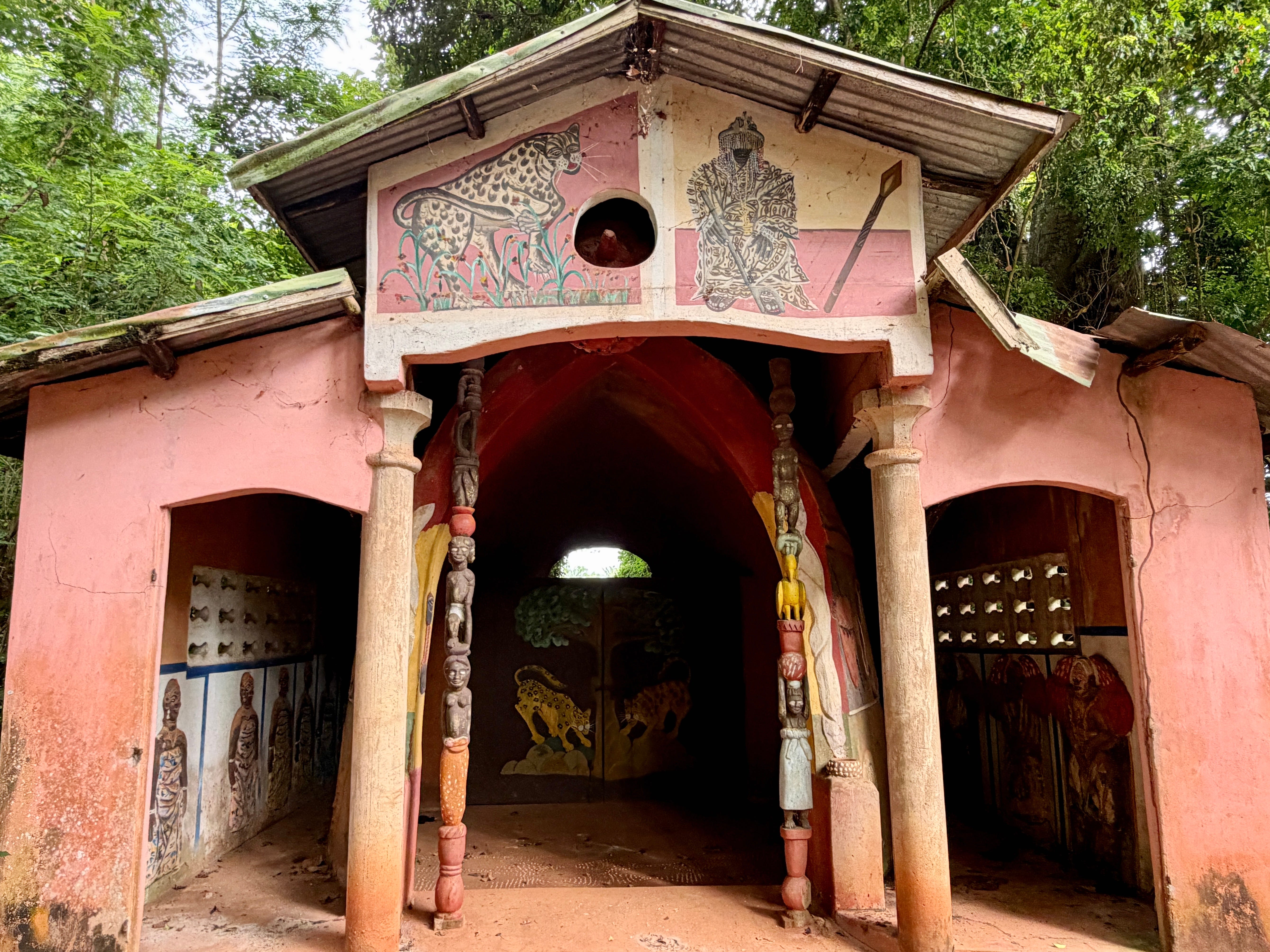
We finally reached the half of the forest towards the back of the grounds that are off-limits to visitors. This pink building served as the dividing line; it’s the Zangbeto, or the Vodun Convent, an important sacred temple where spiritual schooling and initiations take place. The central entrance of the structure is reserved for the priests; the left entrance is for women only, while the right entrance is exclusively for men.


We were strictly forbidden from passing beyond the pink walls or entering the building. Our guide explained that it’s considered a transgression against the deities who guard the grove. One gentlemen stepped onto the raised platform, unintentionally, and was immediately reprimanded, so they do take these prohibitions seriously!
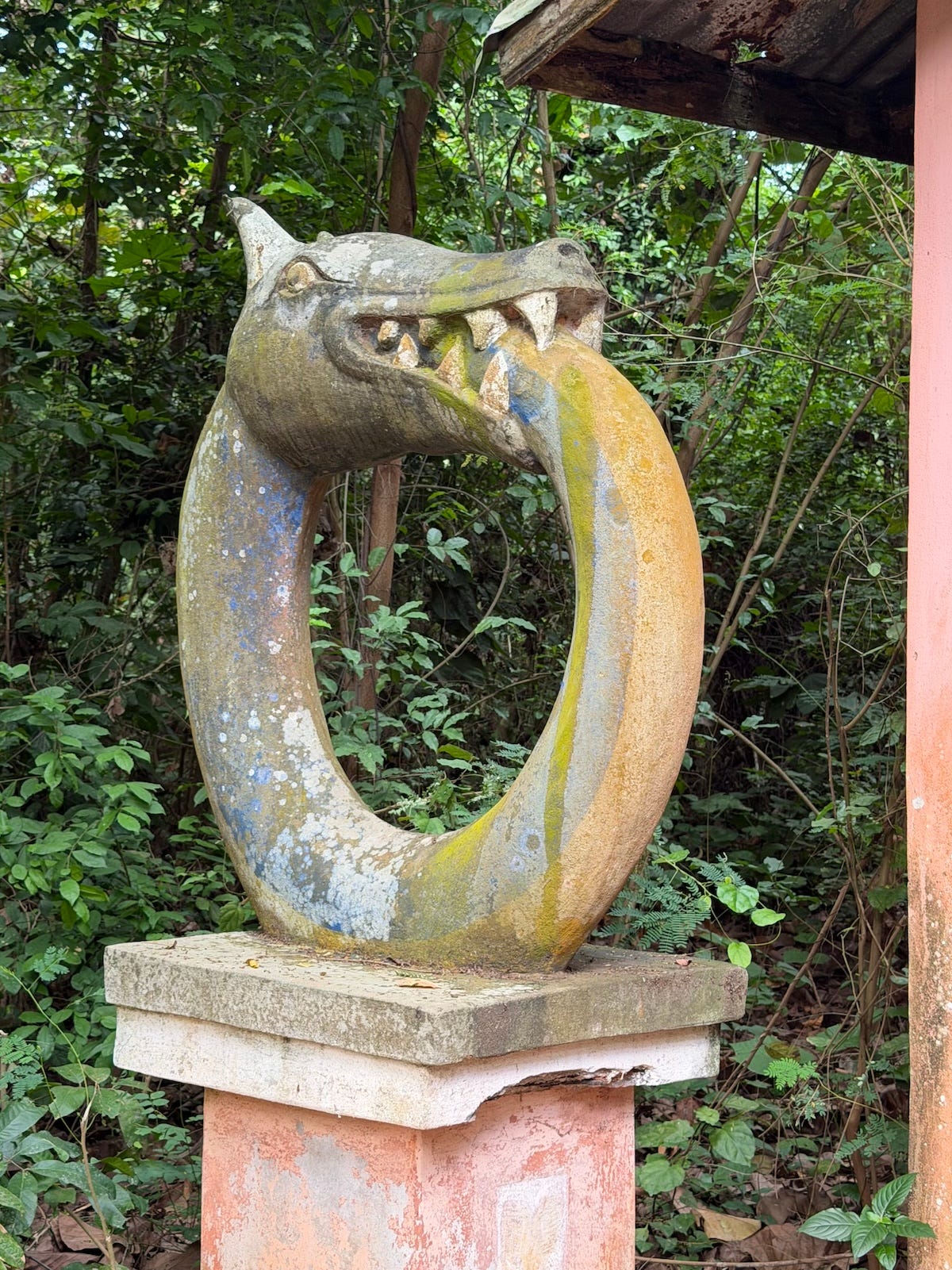
In Beninese Vodun cosmology, this striking circular snake-like sculpture represents the elemental deity that guards the threshold of the secret convent.
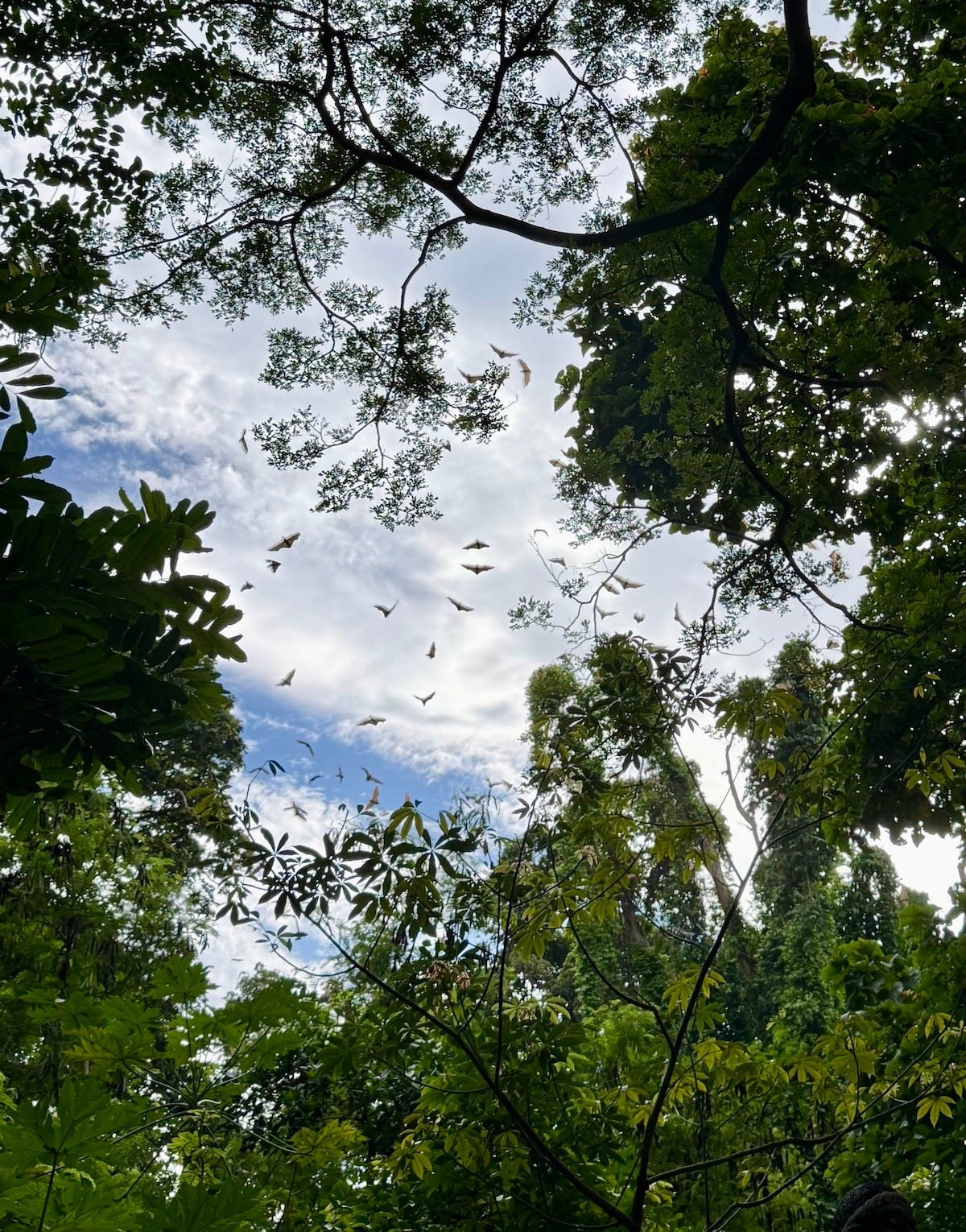
As we were learning about the forbidden, sacred ground, this massive colony of straw-colored fruit bats that had been hanging from the branches of the ancient trees began to swarm. Doing so in daylight is unusual behavior for these nocturnal bats — our guide said perhaps they sensed a predator such as a nearby hawk.
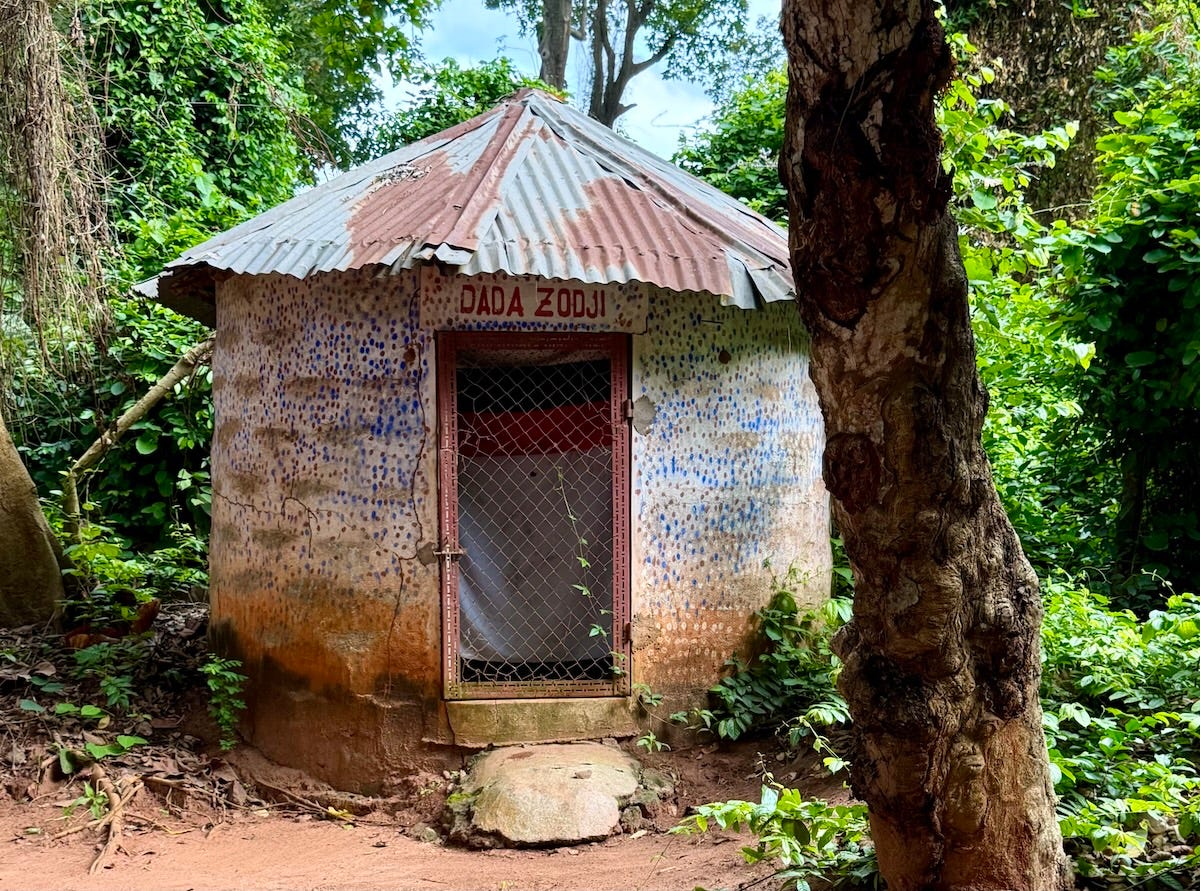
This small temple building, a single room, belongs to high-ranking Vodun priests known as Dada Zodji and serves as an active Sakpata convent, or private spiritual school and sanctuary. The speckled dots on the walls are the sacred symbols of Sakpata — the Earth deity — and represent smallpox rashes and the scars of disease that the deity has the power to inflict or miraculously heal.


On the left is Gou, the ultimate protector of humanity and the patron saint of anyone working with metal. He once was the protector of blacksmiths and warriors, but in these more modern times he is the deity of the yellow-shirted Zémidjan motorcycle riders.. His physical exaggerated ears symbolize his specific spiritual power—that he “hears every single prayer, cry for help, and whisper of distress.”
On the right, is Bokono, the King’s Counsel. He woke from a dream that predicted the king’s death in three days time, but knew he could not speak of such a forbidden thing or he would be put to death. Instead of speaking aloud, Bokono mimed the foretold event in a dramatic courtyard dance for the king’s advisors, the precursor of Beninese folkloric dance rituals.
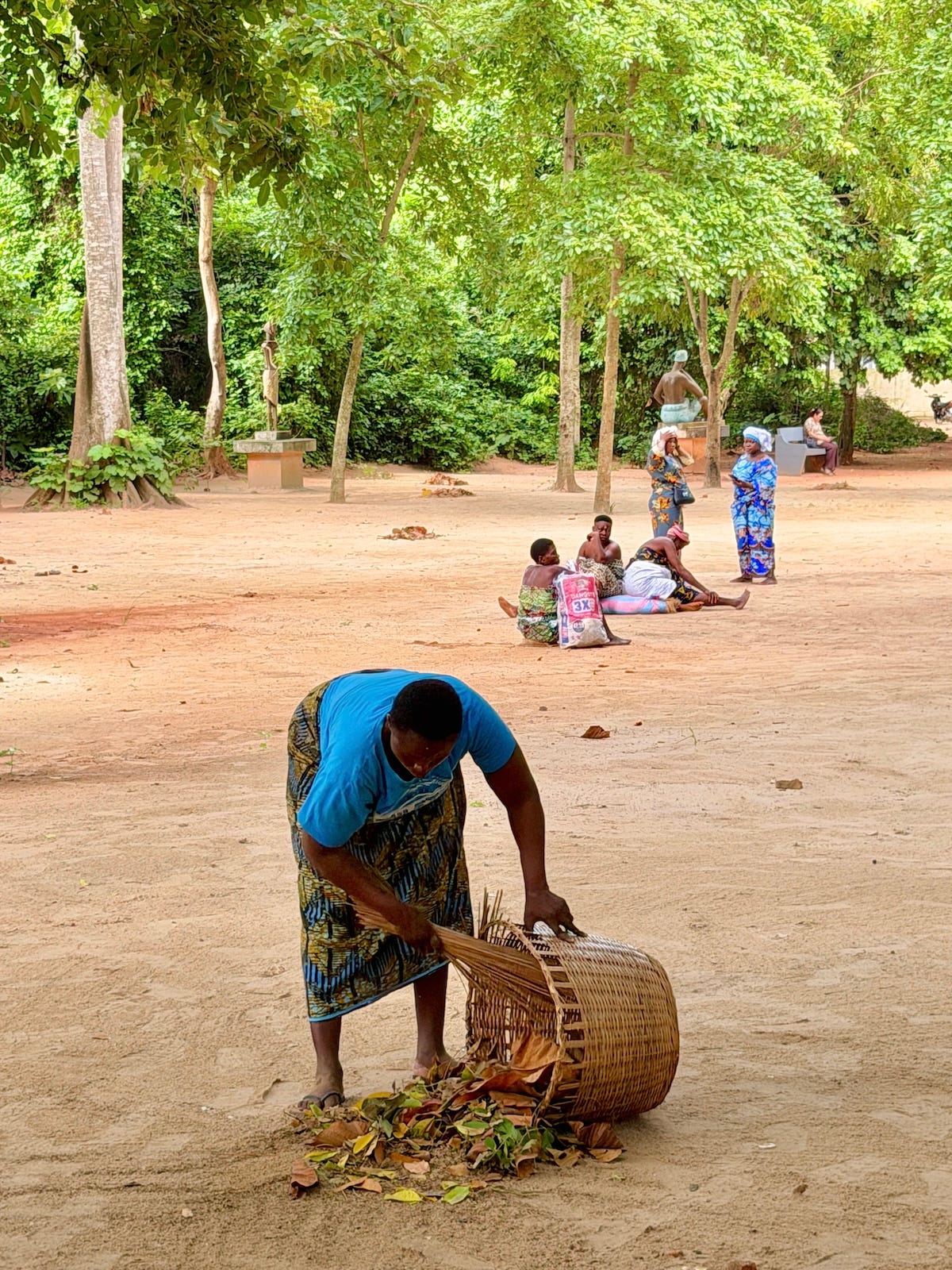
We admired the perseverance of this woman who swept the large dirt courtyard, using only a whisk broom and a basket. She did an exceptional job, as the premises were remarkably free from debris.
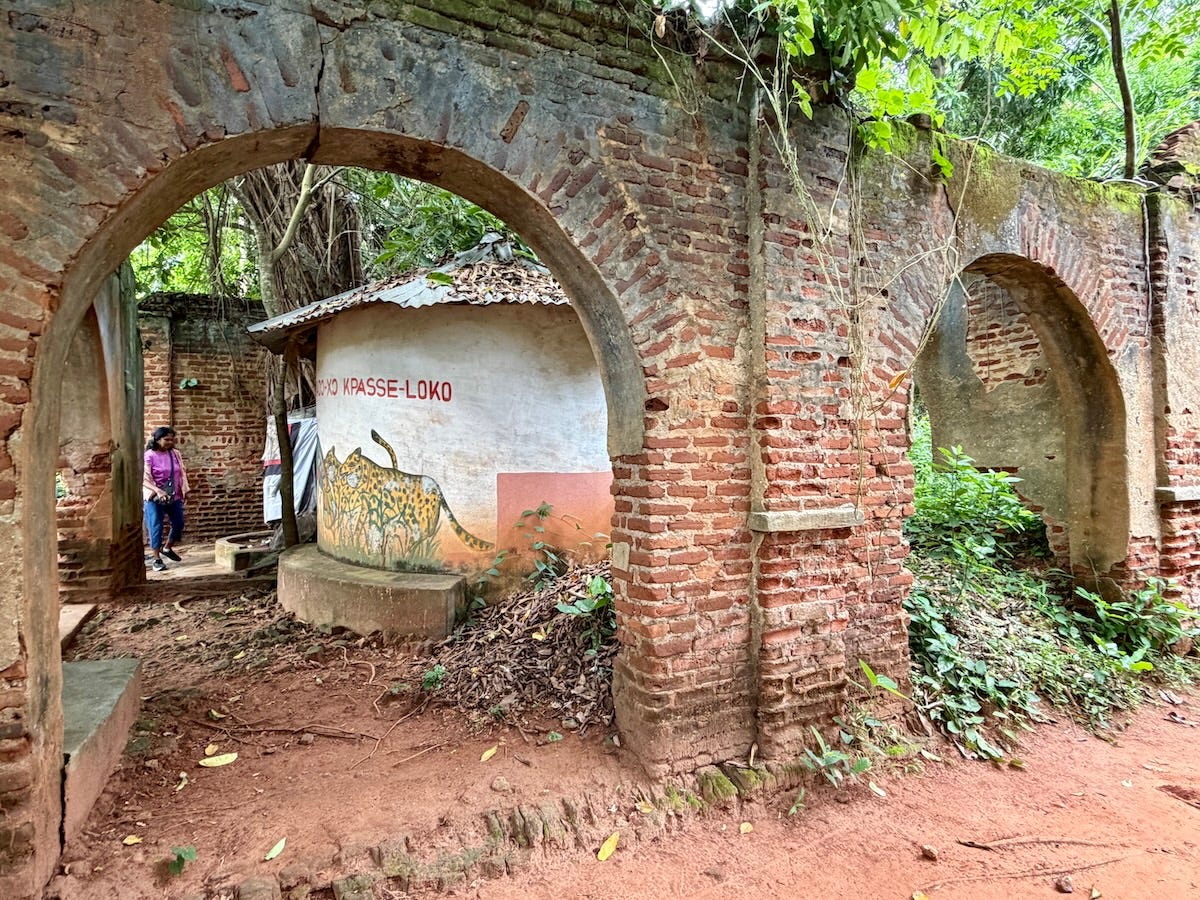
This brick-walled enclosure houses the heart of the Sacred Forest sanctuary — the Sacred Iroko Tree of King Kpassè.
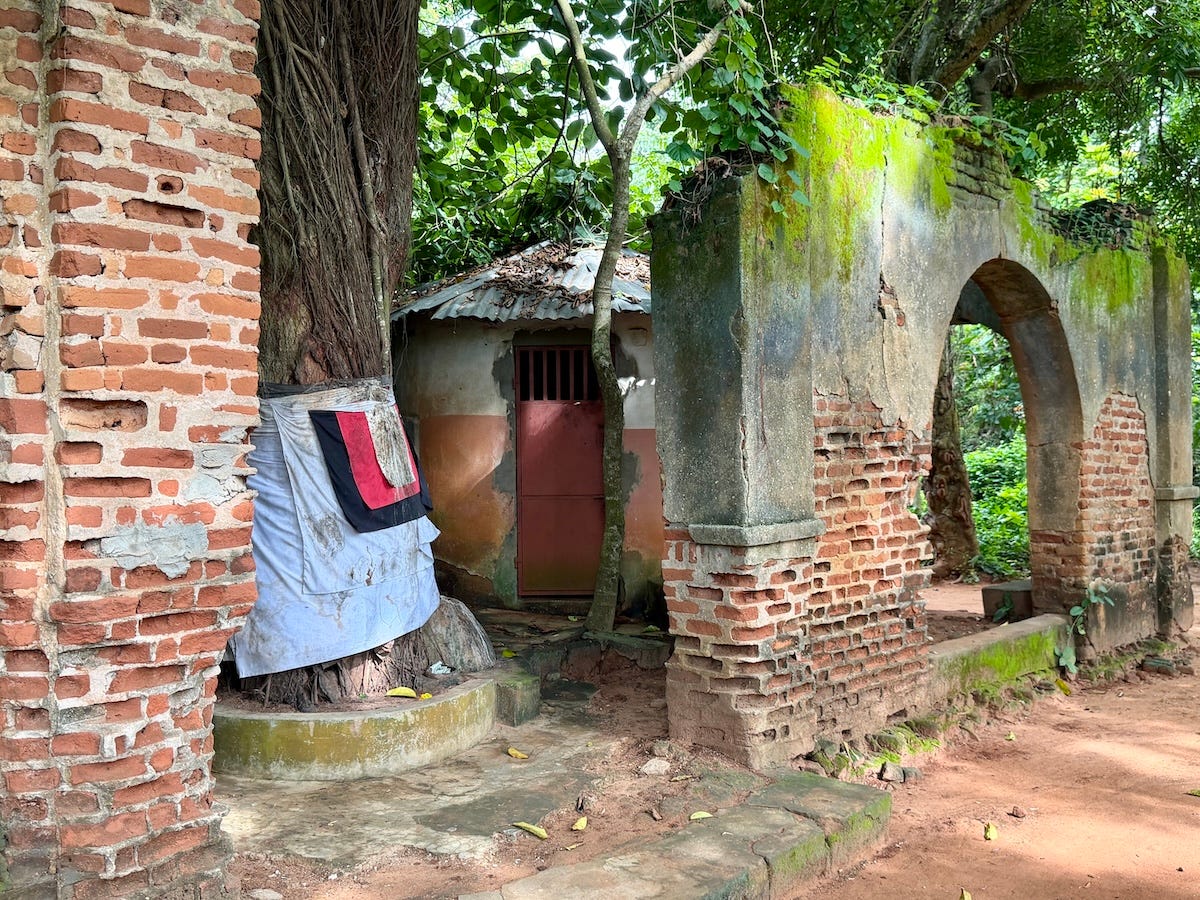
The central, cloth-wrapped African teak, believed to be over 500 years old, dates directly back to the 16th-century reign of King Kpassè. Local Vodun practitioners believe this tree is the actual, physically altered, living reincarnation of King Kpassè’s spirit.
The circular wall with arched openings acts as a protective barrier around the massive trunk, which is kept continuously shrouded in a white cotton cloth wrappers. Well-worn sacred wrappers aren’t removed; a new clean cotton wrap is simply placed on top of the previous ones. According to tradition, the fabric wrapping the trunk transforms the tree into a sacred altar.
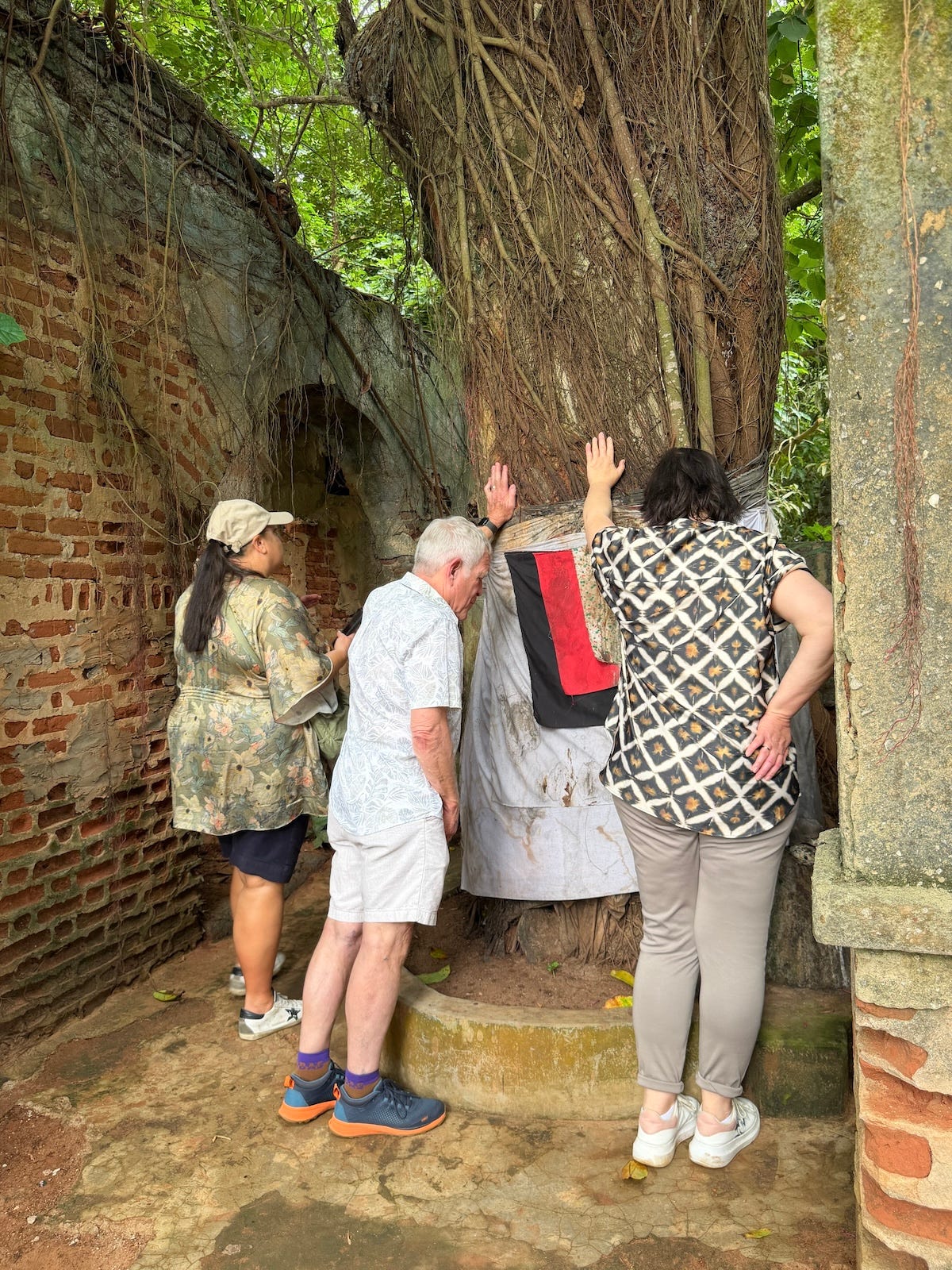
At the base of the tree altar, there was a bowl where we were encouraged to place a physical offering — money — to feed the ancestral spirits. Then we were told we could press our left hands flat against the tree to feel the "heart beat" of the tree and whisper a wish. The request, however, had to be a positive one, something that would be “good to happen,” for it to occur. I wonder what Sherpa wished for?
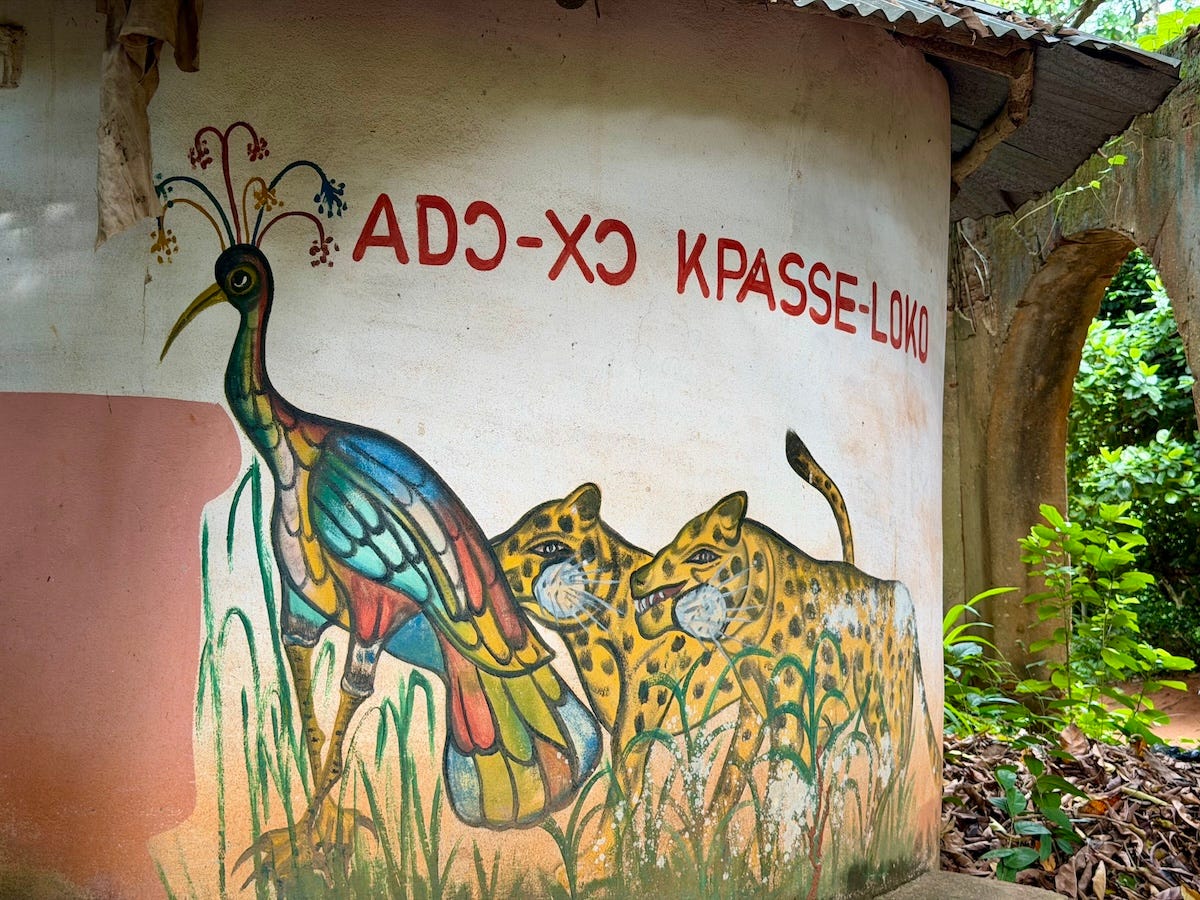
There are painted peacocks on several buildings and also on the outside perimeter of the forest. They are reminders to visitors that King Kpassè never died; he simply shifted into the natural world, and was reincarnated into the giant Iroko tree and the sacred fauna of the grove.
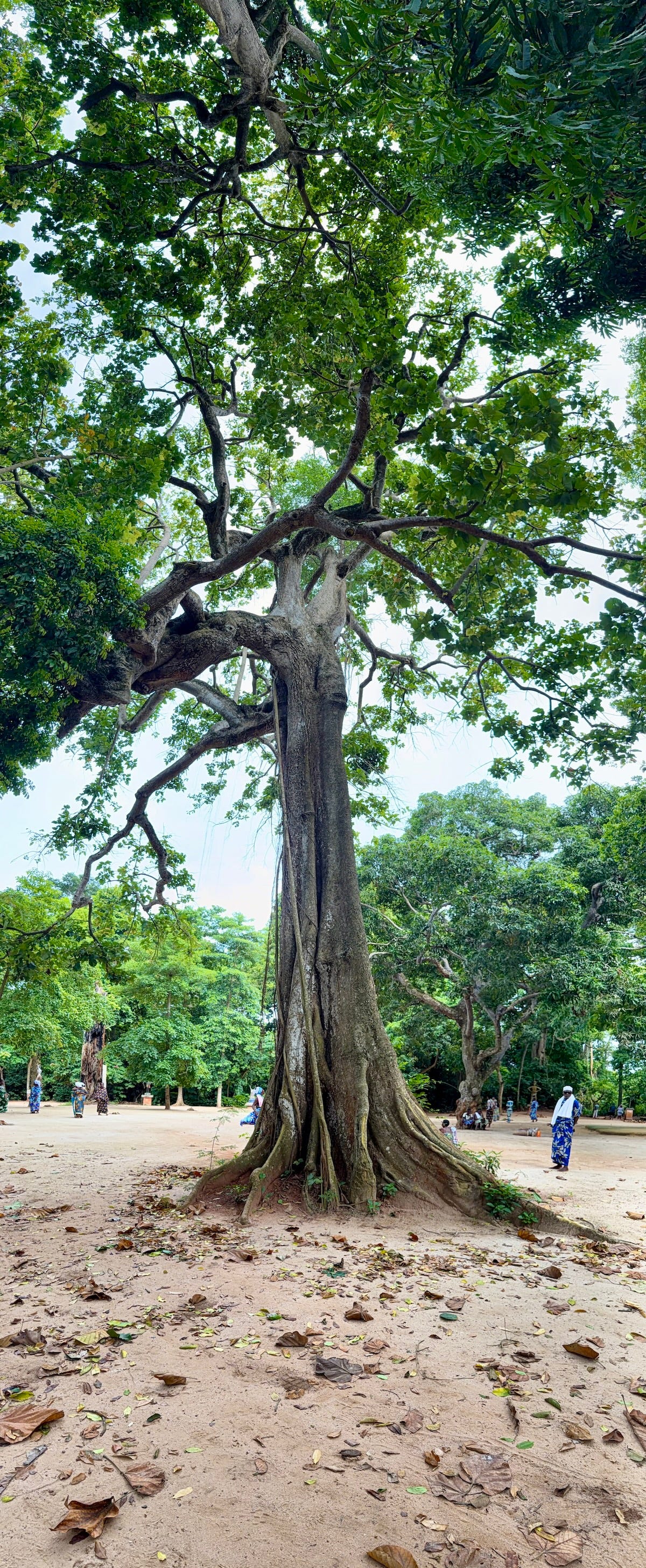
The oldest and most revered trees inside the Sacred Forest are estimated to be around 500 to 600 years old. Because these ancient woods have been protected by Voodoo spiritual laws for centuries, the trees have been completely shielded from logging, allowing them to reach their maximum lifespans. Unusual in a country where trees are highly targeted for logging, construction, and fuel. The trees in this forest really were massive — and gorgeous in their own right.
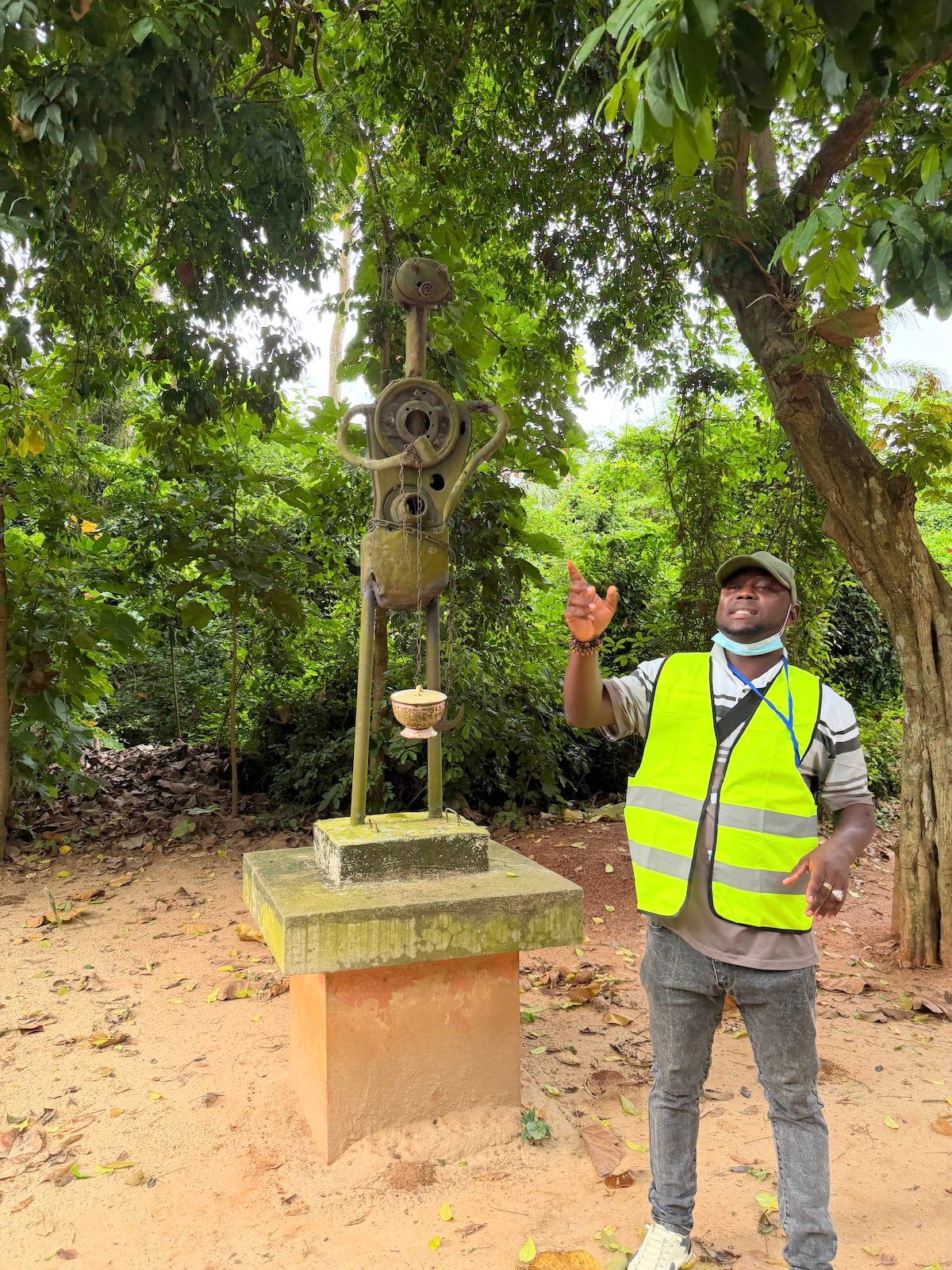
This is one of the last sculptures we stopped at — the Monument to Inter-Religious Tolerance and Peace. Featuring both a symbolic Christian bowl and the Islamic crescent on the same base, it is a powerful reminder of the inter-connections of the religions. It’s quite common for “a person to practice Christianity in the morning and Voodoo at night,” according to our guides. There’s a lot of fluidity and overlap in the various religious practices.


Once our tour concluded, we had an opportunity to stop at the shops before getting on our bus. Although no one purchased drinks or snacks from the cafe — we had earlier been cautioned about consuming fresh beverages or produce — our group did swarm the small gift shop. I’d been on the lookout for a mask since departing Sri Lanka, and found a reasonably-priced beaded mask here.
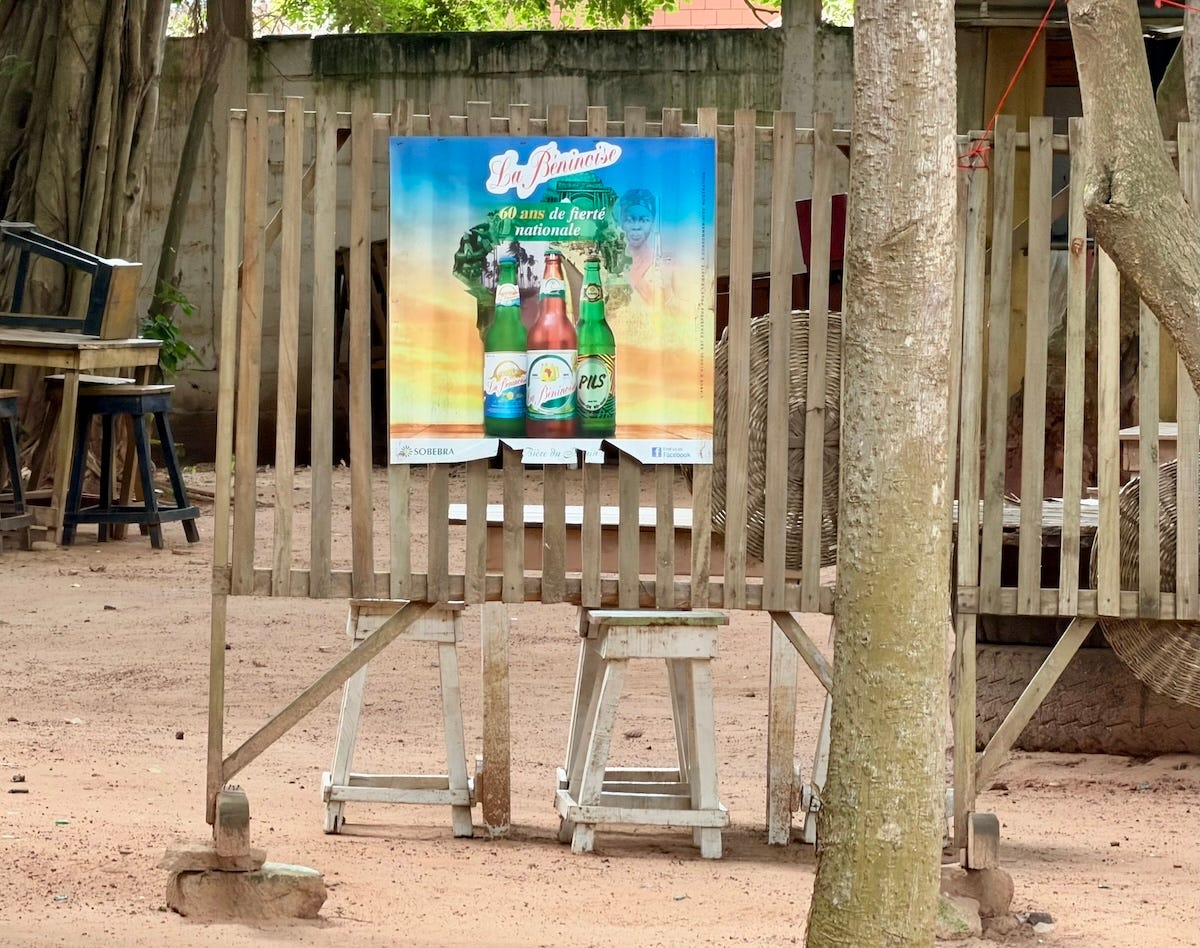
Since we visited in the morning, the restaurant and bar on the premises was closed, however Sherpa snapped a photo of the advertisement for some of the local beers. Now he knows what to search for as he looks for his Beninese Destination Beer.
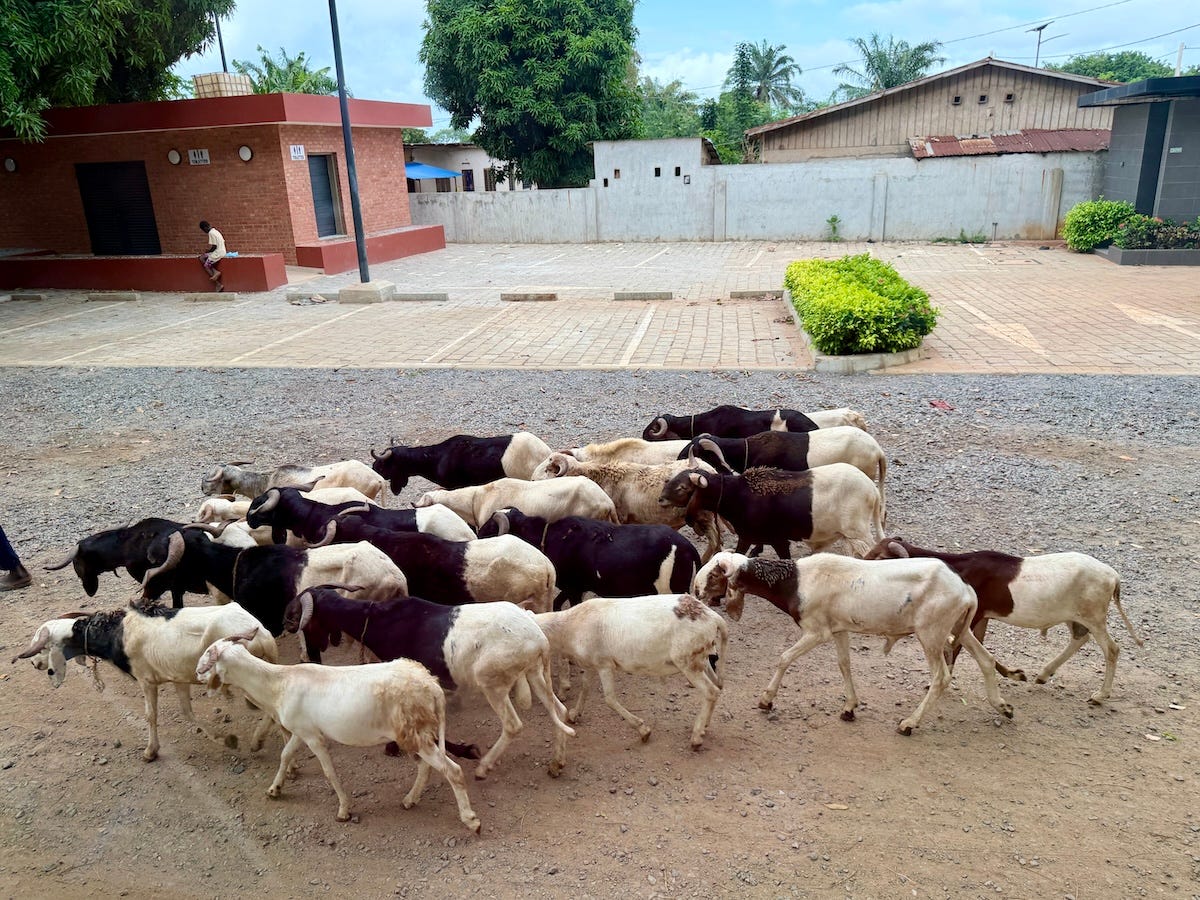
As we were getting seated on our bus, I glanced out my window to see this herd of goats being driven down the road. Not captured in the photo were the two herdsmen, one in front and one behind, each carrying a tree branch, and each about 8 years old.
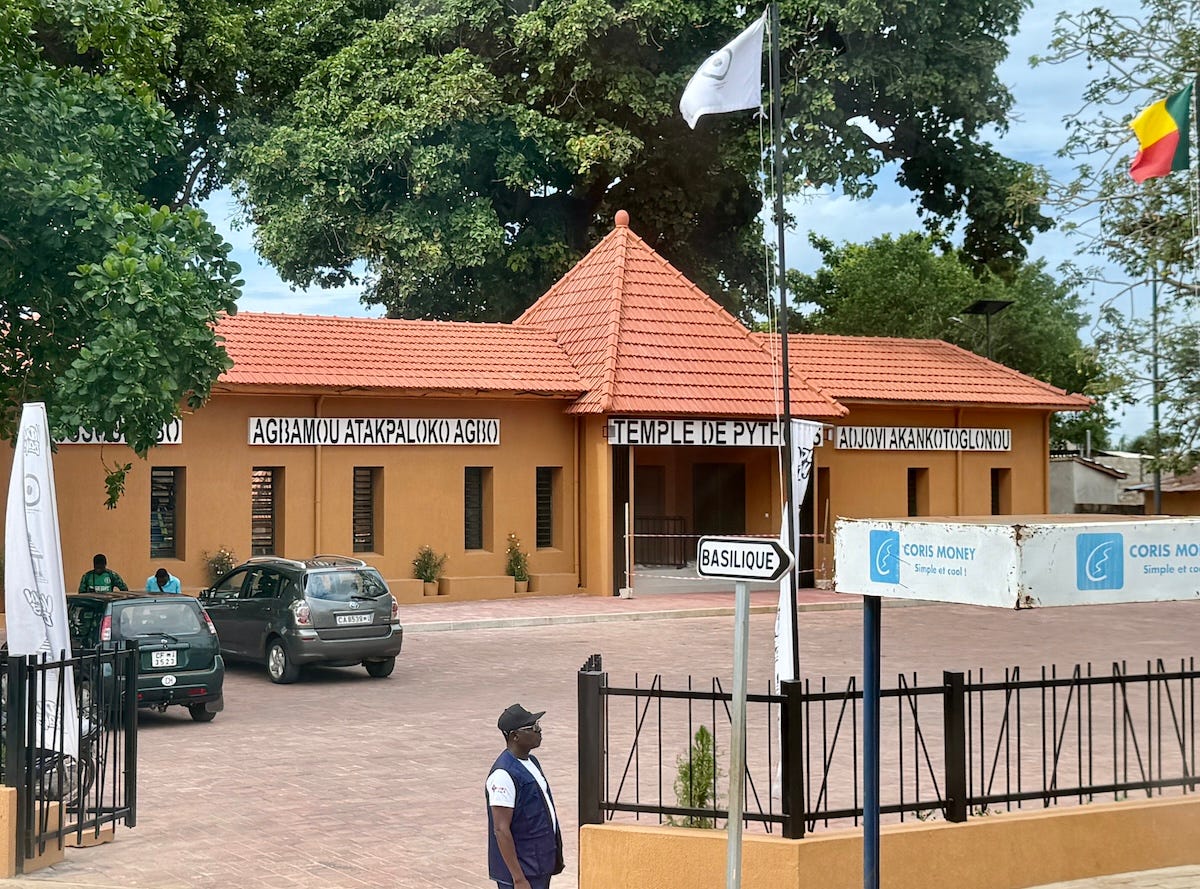
Our next stop was at the Temple of Pythons, an active, historically significant Vodun sanctuary located in the heart of Ouidah. Interestingly, the temple is immediately across the street from the Basilica of the Immaculate Conception, and people really do practice both religions concurrently. The Temple of Pythons serves as the worship center of Dan, the sacred python deity which symbolizes wisdom, life cycles, and protection.
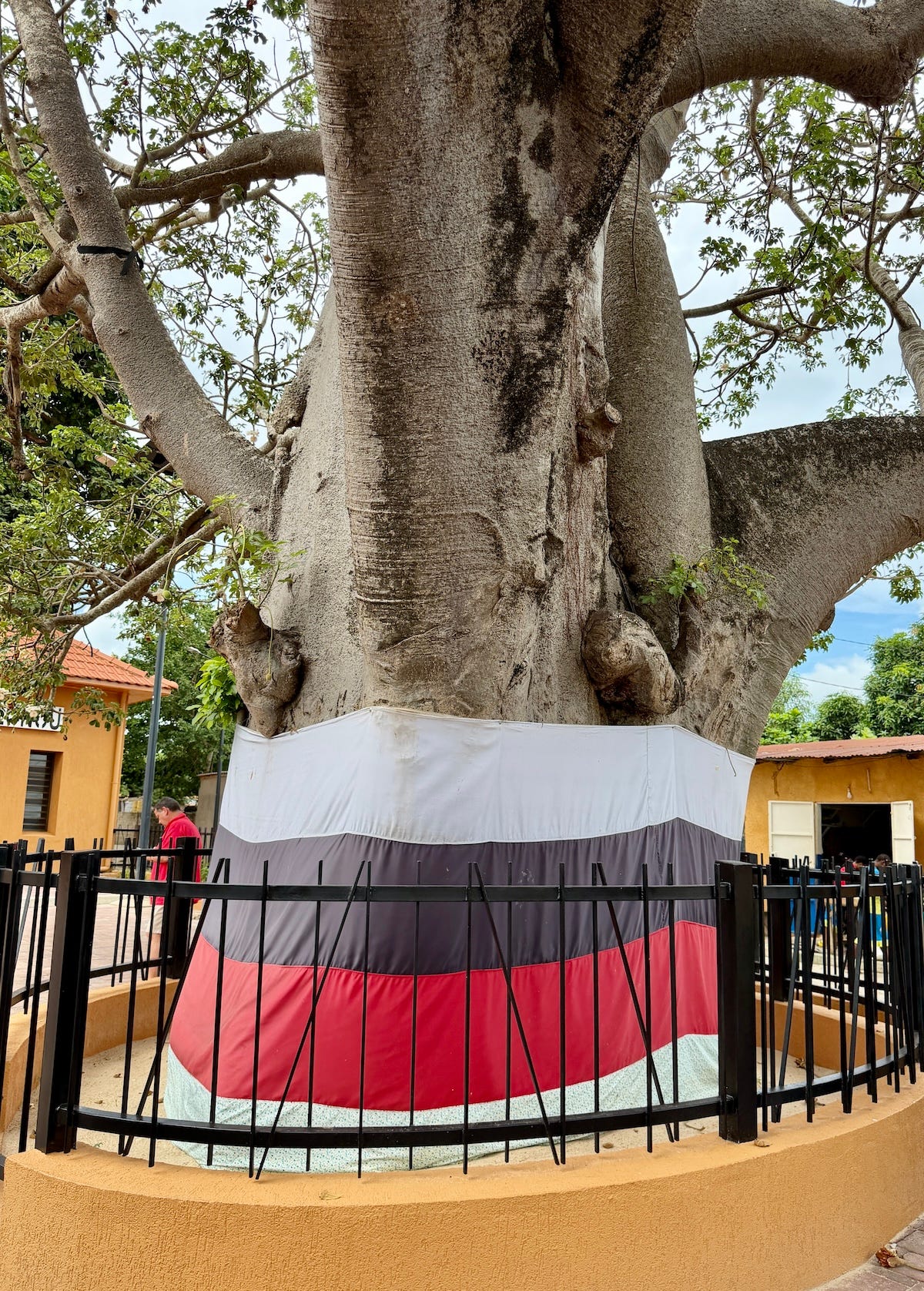
A colossal, 600-year-old Baobab tree dominated the temple’s front yard. It, too, was wrapped in ceremonial cloths and used for ancestral prayer requests.
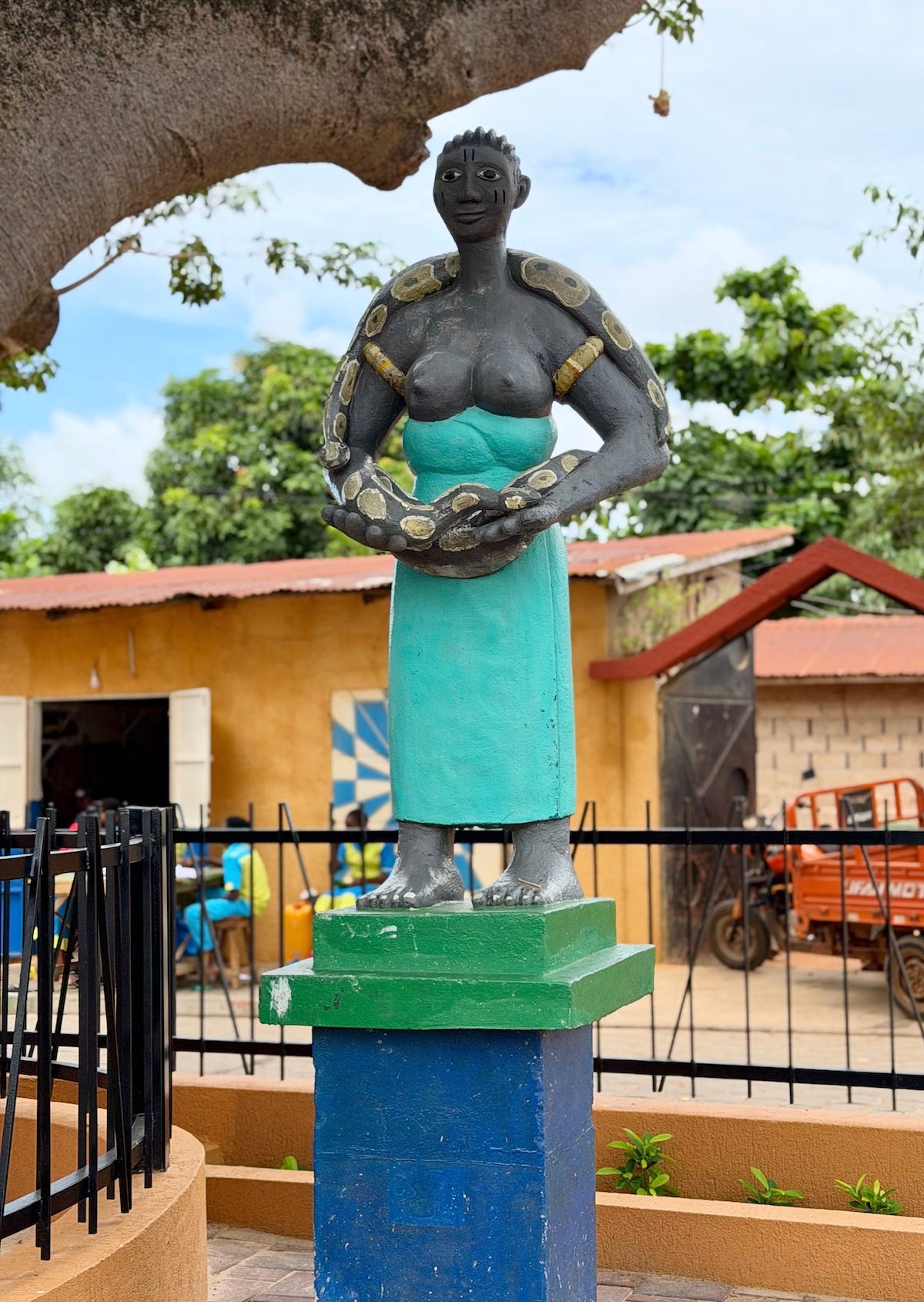
The sculpture nestled near the roots of the 600-year-old baobab represented a Voodoo priestess acting as the maternal guardian of the snakes. Her arms, cradling the python, made a complete circle, perhaps to symbolize the interconnections of the ancestors, the living, and the unborn, all embraced in a protective family circle.
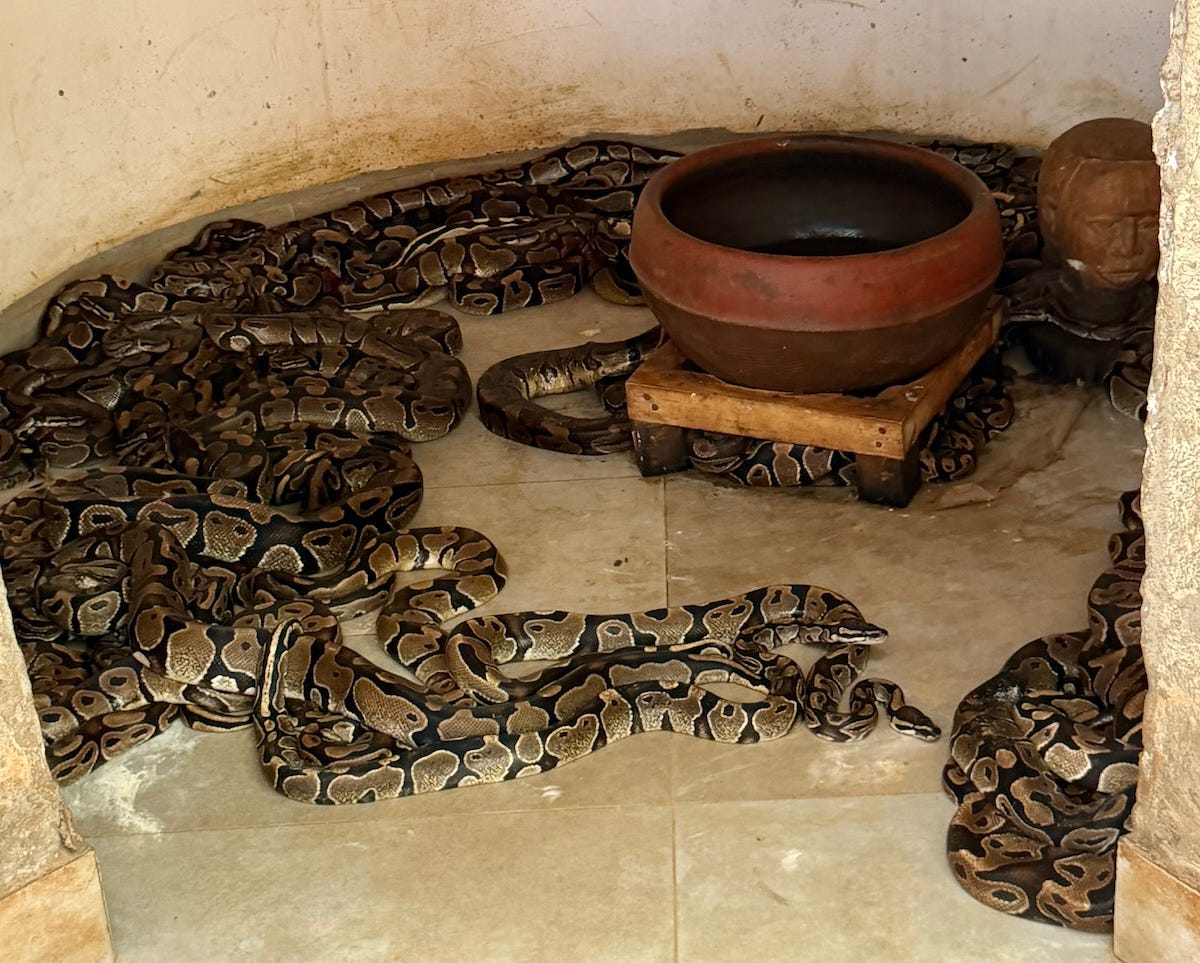
The temple served as the physical home for dozens of Royal Pythons. These snakes move freely throughout the interior compound, though when we visited they were mostly clustered together in this small chamber. In local Xweda folklore, they are revered as protectors who once saved a fleeing king from capture in the 1700s.
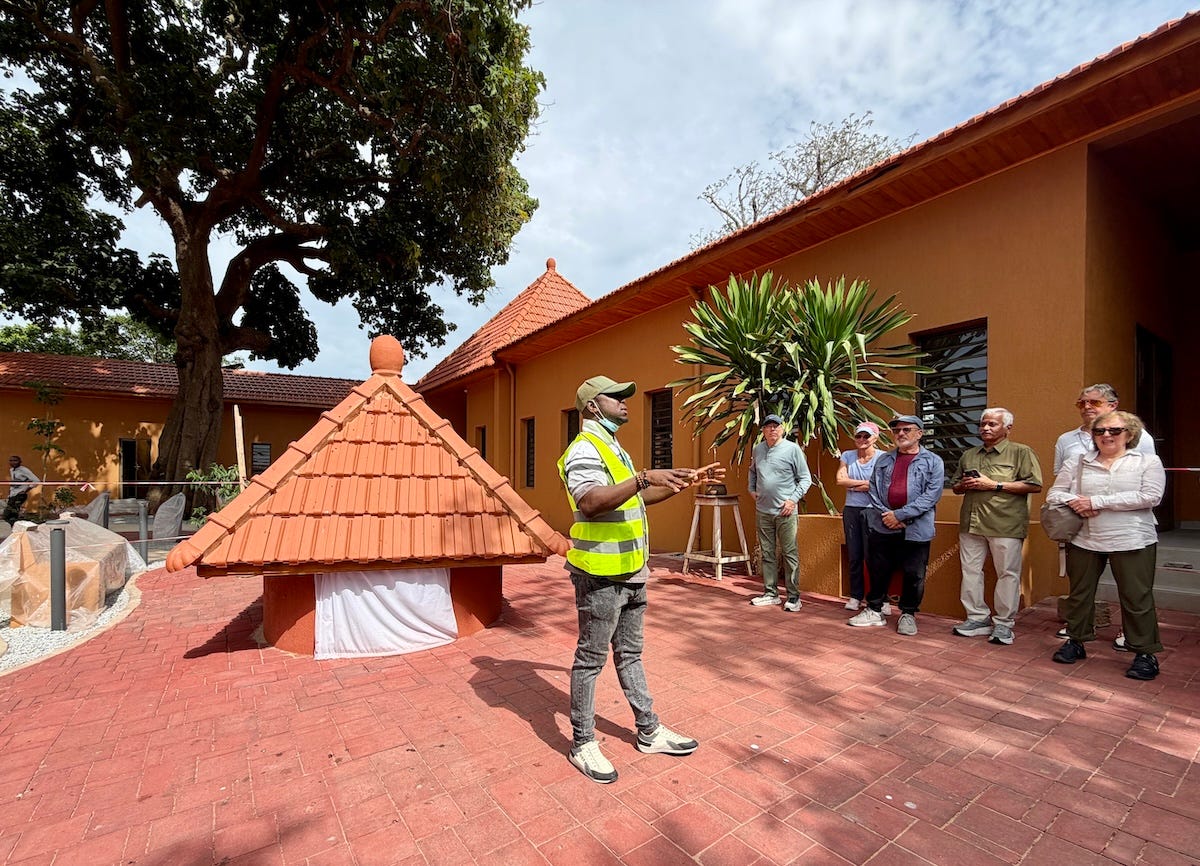
We were invited to hold a python if we wished. The majority of our tour did indeed want to participate! First, the temple guide introduced us to basic snake-handling protocols. Because royal pythons are naturally docile, non-venomous, and accustomed to human contact, this was straightforward and mostly common sense — “don’t move quickly, don’t squeeze the snake…”
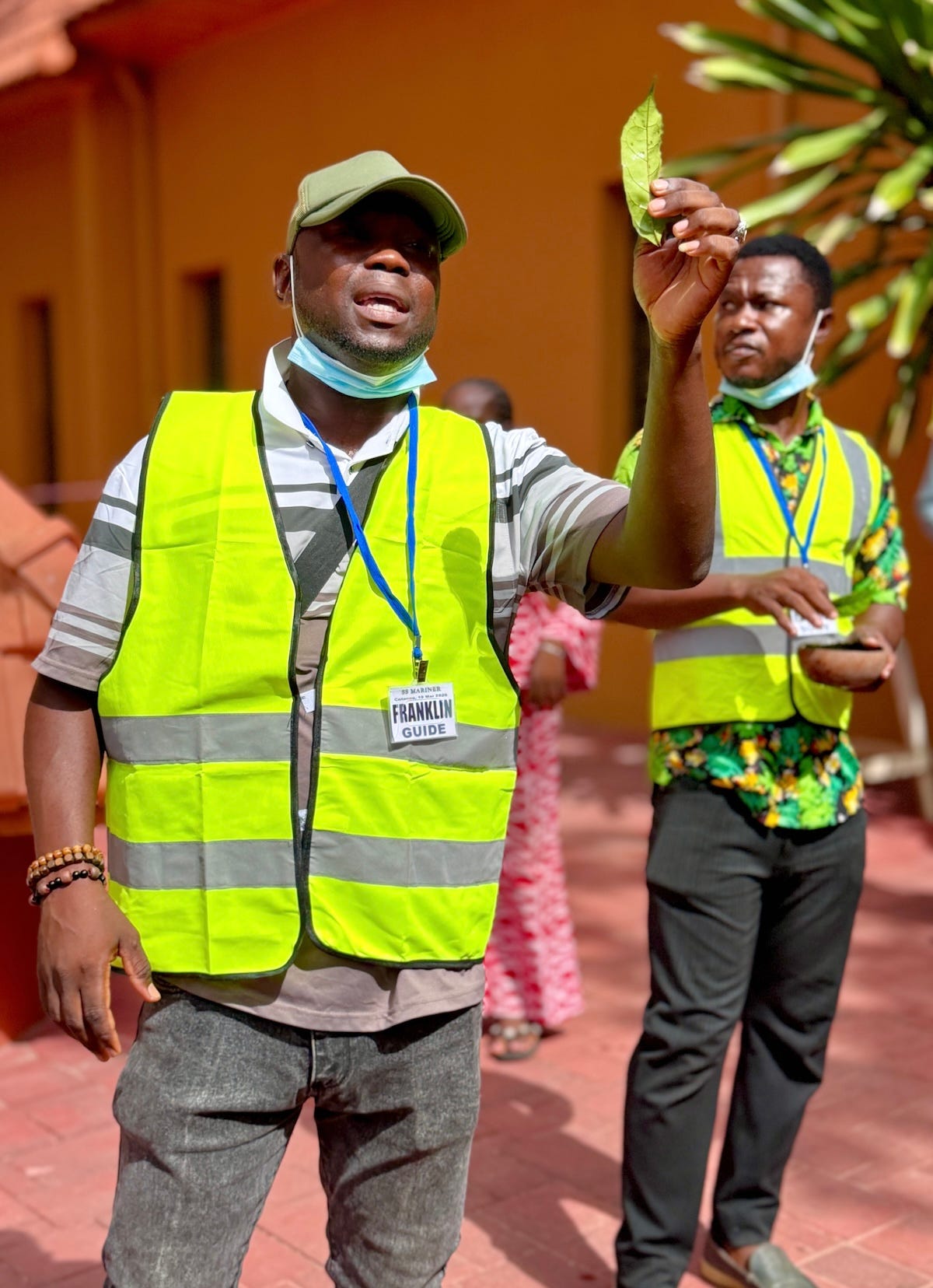
We cleansed our hands with a Baobab leaf that had been dipped in sacred water. and then it was time to hold a python!


Sherpa thought the experience was “fine, it was nice.” I, on the other hand, LOVED holding the python. I talked to it, looked it in its eyes, felt its dry, almost velvety, skin, and did not want to relinquish the snake to the temple guide. What an experience. I could have stayed there for hours, walking around with that python draped around my neck!
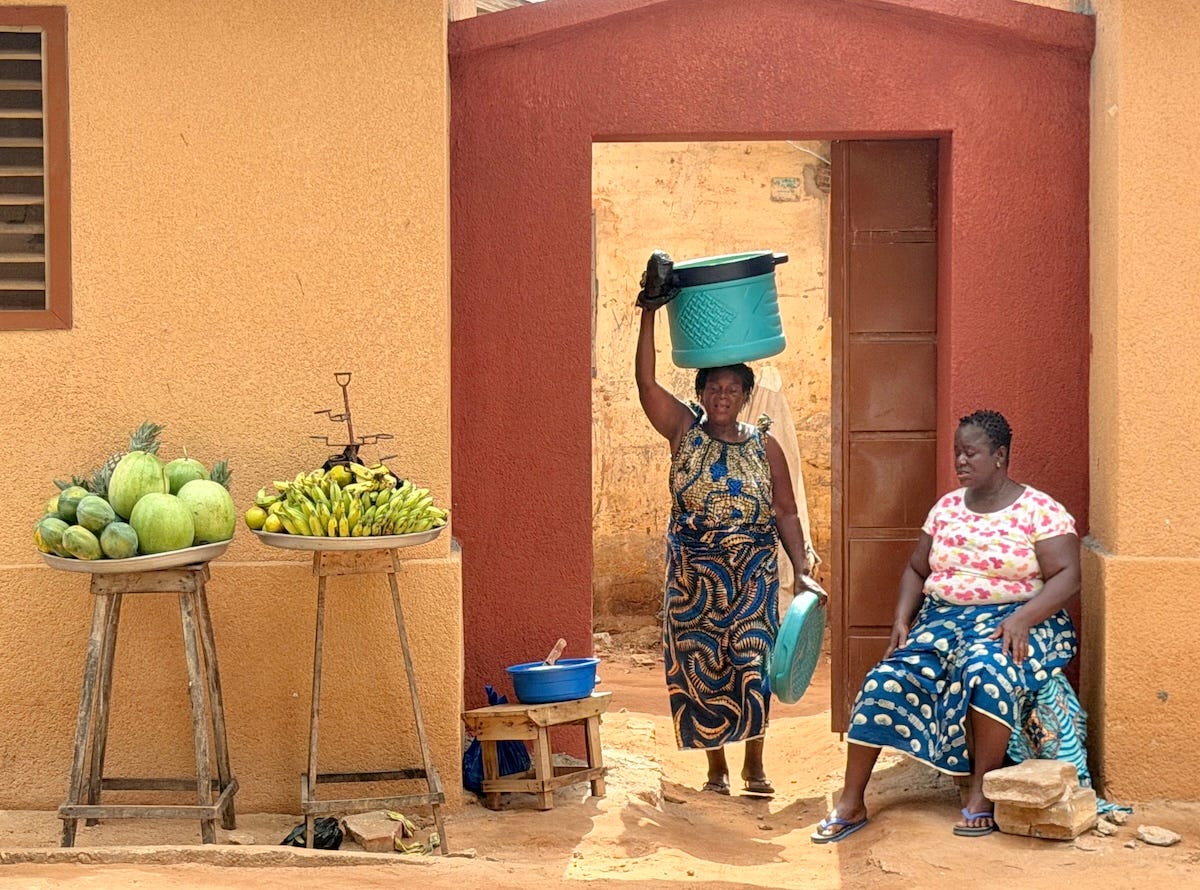
As we were leaving the Python Temple, with me still high on my tactile interaction with that gorgeous python, I noticed this domestic scene across the street from the side exit. Actually, I first noticed the green fruits on the two wooden tables, the red and gold walls, and the seated woman. As I raised my camera, the younger woman balancing the blue pot stepped into the doorway, framing the composition perfectly. I was so pleased, I asked Sherpa to walk across the street and give the women a dollar bill I kept in my pocket for tipping. She was shocked —and appreciative. Maybe it was the snake energy, this feeling of serendipity and good luck! Interesting stuff!
Next post: I’m going to continue the second part of our excursion, the sites that focus on the Slave Trade, in my next article. The two stops which focused on the Voodoo practices got a bit photo-intense and lengthy!
I’ve been following your travels in Africa as we did most of these ports with Regent in 2024. We did a short excursion in Benin as I was not feeling up to snuff so I was particularly fascinated with your description of the python ceremony.
We are avid collectors of tribal art. Many years go we purchased a sculpture at a flea market in Atlanta. It depicts a python either consuming or releasing a man with African features. The story that came with the purchase was that it was a carved tree root pulled from a river in Tennessee and had been in the closet under the stairwell of the family farm for many years.
I always wondered if the sculpture referenced African animism which would have been very much frowned upon on the Christian south.
I’m unable to post a photo to this note. so, if interested, please email me at forgap@bellsouth.net
PS. We met you earlier this year on the Splendor cruise of the eastern Caribbean. I followed your reporting and introduced myself and my husband in the reception area. We are Jennifer Errion and George Perla